Plastic crusher
1. Introduction
Global plastic production has surpassed 400 million tons annually, yet only 9–35% is effectively recycled [1]. In China—the world’s largest plastic producer and consumer—62 million tons of waste plastic were generated in 2024, of which 19.5 million tons were recovered, yielding a national recycling rate of 31.5% [1]. Crucially, over 75% of this recovered material must undergo mechanical size reduction before further processing, placing plastic granulators at the heart of the recycling value chain.
Once viewed as simple “shredding tools,” modern granulators have evolved into intelligent, energy-efficient systems that directly influence the quality, cost, and sustainability of再生塑料 (regenerated plastic). This paper synthesizes current technological capabilities, market dynamics, and policy frameworks shaping the industry as of early 2026.
2. Working Principle and Core Components
A typical plastic granulator operates via shear-based comminution: an electric motor drives a rotor equipped with rotating knives that pass closely by stationary knives, cutting plastic feedstock into granules. The particle size is controlled by interchangeable screen meshes (commonly 3–12 mm), while airflow or conveyor systems remove fines [4].
Key components include:
- Rotor & Knives: Made from high-hardness alloys (e.g., SKD11, DC53); some feature laser-clad edges for enhanced wear resistance [6].
- Motor & Drive: Power ranges from 3.5 kW to 150 kW, with speeds of 150–500 rpm [4]. VFDs now allow real-time speed adjustment based on load [2].
- Chamber Design: Options include single-shaft (for sprues/runners), twin-shaft (for bulky items like car bumpers), and ultra-fine grinders (up to 100 mesh) [2][3].
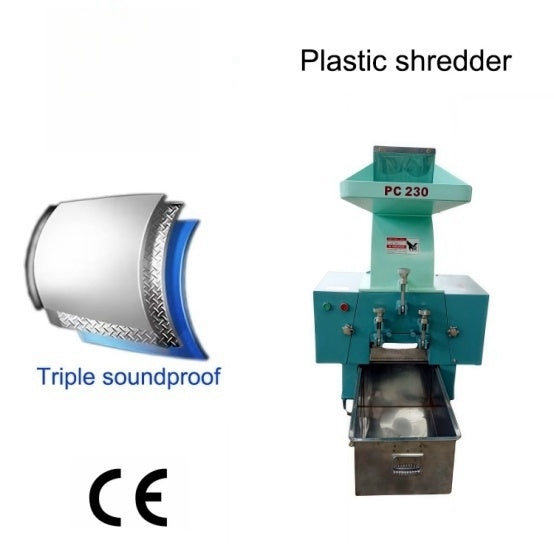
- Safety Systems: Overload protection, phase-loss detection, and dual-layer sound-insulated hoppers are standard [4][6].
3. Technological Innovations (2020–2026)
3.1 Energy Efficiency & Noise Reduction
Under China’s mandatory GB 38507-2024 standard, granulators are classified into three energy tiers. Leading models now achieve 0.11 kWh/kg—a 25% improvement over legacy units [1]. Noise control has also advanced: Ningbo Snowdell’s dual-chamber design with acoustic foam reduces operational noise to 65 dB, compliant with urban zoning laws [2].
3.2 Intelligent Operation
PLC and IoT modules enable:
- Real-time monitoring of motor current, bearing temperature, and vibration,
- Automatic reversal during jams (reducing downtime by >30%) [2],
- Remote diagnostics and predictive maintenance [6].
Zhangjiagang Beno’s hydraulic auto-clear system exemplifies this trend, eliminating manual intervention during blockages [2].
3.3 Modular & Customized Design
Manufacturers now offer rapid customization:
- Infeed sizes up to 1200 mm for large appliance housings [2],
- Adjustable cavity structures for biomass fuel (3–5 mm) or PET flakes (95% pass at 100 mesh) [2][3],
- Modular tooling kits that cut delivery time from 30 to 15 days [2].
4. Performance Validation: Case Studies
| Company | Application | Key Results |
|---|---|---|
| Ningbo Snowdell | E-waste housing (500 t/yr) | Efficiency ↑90% (2→3.8 t/h); knife cost ↓83.75%; noise = 68 dB [2] |
| Zhangjiagang Beno | PE edge trim (800 t/yr) | Pre-sorting cost ↓70.8%; downtime ↓70.8%; annual savings >¥150,000 [2] |
| Zhejiang Fengli | Wood-plastic biomass (1000 t/yr) | Particle compliance ↑96%; combustion efficiency ↑10%; eligible for carbon subsidies [2] |
These cases confirm that advanced granulators deliver ROI within 12–18 months through energy, labor, and maintenance savings.
5. Market Structure and Policy Drivers
China’s plastic granulator market reached ¥6.8 billion in 2024, growing at a 9.3% CAGR since 2019 [1]. The industry is concentrated in Guangdong, Shandong, Jiangsu, Zhejiang, and Hebei, which account for 68% of national recovery volume and 70% of crushing capacity [1].
Policy interventions are reshaping competition:
- GB 38507-2024 mandates minimum efficiency thresholds, phasing out non-compliant units.
- 156 cities have established integrated waste sorting–recycling systems, boosting feedstock quality [1].
- The “dual carbon” strategy incentivizes low-emission equipment, with some provinces offering 10–15% subsidies for Tier-1 granulators [1][3].
Consequently, the top 10 firms’ market share (CR10) rose from 8.2% (2019) to 18.5% (2024), signaling ongoing consolidation [1].
6. Classification and Application Scenarios
Granulators are tailored to material type and form:
| Type | Suitable Materials | Features |
|---|---|---|
| Single-Shaft Granulator | Injection molding sprues, film, bottles | High-speed; fine output; ideal for clean, homogeneous streams |
| Twin-Shaft Shredder | Car bumpers, drums, mixed e-waste | Low-speed, high-torque; handles contamination and large geometries |
| Ultra-Fine Grinder | PET, engineering plastics | Two-stage crushing; achieves 100-mesh powder for compounding [2][3] |
Downstream demand is dominated by packaging (56%), followed by automotive (12% CAGR), construction, and electronics [1].
7. Challenges and Future Outlook
Despite progress, barriers remain:
- Technical fragmentation: 22% of small processors still use non-standard, polluting equipment [1].
- Material complexity: Mixed-color, multi-layer, or glass-filled plastics challenge uniform crushing.
- Cost of intelligence: Smart features add >20% to upfront cost, deterring micro-enterprises [9].
Future development will focus on:
- AI-driven adaptive control that auto-adjusts parameters based on real-time feed composition,
- Closed-loop water/dust management to meet stricter emission limits (<2 mg/m³ particulates) [1],
- Integration with full recycling lines (crushing → washing → drying → pelletizing) for turnkey solutions [7].
As global plastic treaty negotiations advance and EPR (Extended Producer Responsibility) schemes expand, granulators will evolve from standalone machines to intelligent nodes in digital recycling ecosystems.
8. Conclusion
Plastic granulators have transcended their mechanical origins to become sophisticated, policy-aligned instruments of circularity. By delivering precision size reduction with minimal energy, noise, and waste, they unlock the economic and environmental value embedded in plastic scrap. With China’s market maturing under regulatory pressure and technological innovation, the next generation of granulators will not only crush plastic—but also help rebuild a sustainable materials future.
-
Đăng trong
Plastic crusher