Water-Cooled Chillers: Technology, Applications, and the Path Toward Sustainable Industrial Cooling
1. Introduction
As global industrialization accelerates and climate regulations tighten, the demand for reliable, energy-efficient thermal management has surged. Among all cooling technologies, water-cooled chillers stand out for their ability to maintain precise temperatures (±0.1°C), operate quietly, and deliver high cooling capacity with lower total cost of ownership (TCO) over long duty cycles [2][4].
Widely deployed in chemical reactors, MRI machines, injection molding lines, and chip fabrication facilities, these systems use water—not ambient air—as the primary heat rejection medium, decoupling performance from outdoor weather conditions [3][5]. With the global market projected to reach $15 billion by 2025 (CAGR: 5.2%) and China accounting for over 25% of production, water-cooled chillers are central to the green transition in manufacturing [5].
2. Working Principle and System Architecture
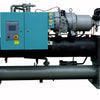
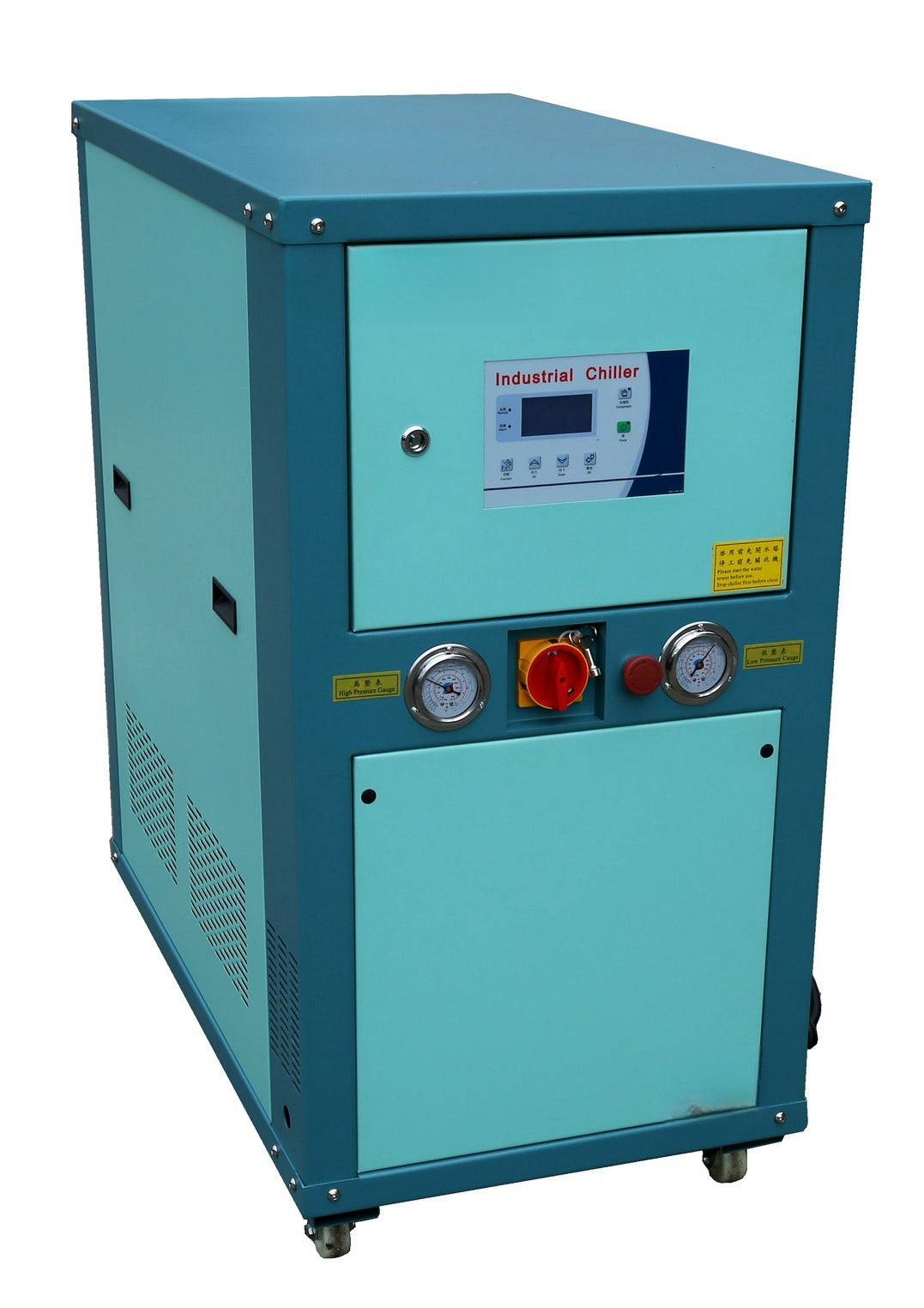
A typical water-cooled chiller operates on the vapor-compression refrigeration cycle, comprising four key stages:
- Compression: A hermetic screw, scroll, or centrifugal compressor raises low-pressure refrigerant vapor (e.g., R134a) to high pressure and temperature.
- Condensation: Hot gas enters a shell-and-tube water-cooled condenser, where circulating cooling tower water absorbs heat, condensing the refrigerant into liquid.
- Expansion: The high-pressure liquid passes through a thermostatic expansion valve (TXV), dropping pressure and temperature to form a cold liquid-vapor mixture.
- Evaporation: In the evaporator, this mixture absorbs heat from the process water loop, producing chilled water (typically 7–12°C), while the refrigerant vaporizes and returns to the compressor [2][6].
This closed-loop design ensures consistent heat transfer even in dusty, high-temperature (>35°C), or enclosed environments where air-cooled units would overheat [4].
3. Core Components and Performance Metrics
| Component | Function | Modern Innovations |
|---|---|---|
| Compressor | Drives refrigerant cycle | High-efficiency screw compressors (e.g., Danfoss, Bitzer); VSDs for part-load optimization |
| Evaporator | Absorbs heat from process water | Falling-film or flooded designs for 15–20% higher heat transfer [3] |
| Condenser | Rejects heat to cooling tower water | Enhanced tube surfaces; corrosion-resistant materials (SS316) |
| Refrigerant | Heat transfer medium | Shift from R22 to R134a, R410A, and now low-GWP options like R1234ze (GWP <1) [3] |
Key performance indicators include:
- COP (Coefficient of Performance): Typically 4.5–6.5 under standard conditions (ARI 550/590).
- IPLV (Integrated Part Load Value): Measures real-world efficiency across 100%, 75%, 50%, and 25% loads—critical for variable-demand applications [1].
- Noise Level: <65 dB(A), significantly quieter than air-cooled counterparts—ideal for hospitals and labs [4].
4. Technological Advancements (2020–2026)
4.1 Intelligent Control Systems
Leading manufacturers now integrate IoT sensors and AI algorithms for real-time optimization. For example, Kainuo Machinery’s smart chillers use adaptive logic to adjust compressor speed, pump flow, and cooling tower fan based on load forecasts, reducing energy use by 8–12% [3]. Remote monitoring via cloud platforms enables predictive maintenance and fault diagnostics.
4.2 Large ΔT Operation
Studies show that increasing chilled water temperature difference (e.g., from 5°C to 8–10°C) reduces flow rate and pump power by up to 30% without compromising cooling capacity [7]. Modern chillers support such configurations through optimized heat exchanger sizing and control logic.
4.3 Eco-Friendly Refrigerants
Driven by the Kigali Amendment and EU F-Gas Regulation, the industry is transitioning to low-GWP refrigerants. R513A (GWP=573) and R1234ze (GWP<1) are now commercially viable in mid-capacity chillers, with minimal retrofitting required [3].
4.4 Modular & Customized Solutions
Companies like CoolinTime offer compact, integrated units for space-constrained applications (e.g., PCB laser cutting), featuring magnetic dust filters, quick-connect fittings, and ±0.1°C stability—critical for semiconductor yield improvement [4].
5. Industrial Applications
| Sector | Application | Key Requirements |
|---|---|---|
| Plastics | Injection molding, blow molding | Stable mold temperature; rapid response |
| Biopharma | Fermenters, lyophilizers | Ultra-precise control (±0.1°C); cleanroom compatibility |
| Electronics | Laser marking, chip testing | Low vibration; quiet operation |
| Medical | MRI, CT scanners | High reliability; minimal EMI |
| Data Centers | Server rack cooling | High IPLV; redundancy support |
In one case, a biotech firm using CoolinTime’s Q-series chiller reported 15% higher reaction consistency and 20% lower energy bills after switching from air-cooled units [4].
6. Market Landscape and Sustainability Outlook
China dominates both production and innovation in mid-tier water-cooled chillers. Companies like Dawoxi (Shenzhen), Kainuo (Dongguan), and Dehong (Wuxi) now compete globally by offering:
- Cost-effective customization,
- Rapid delivery (<8 weeks),
- Compliance with CE, ISO 50001, and China’s “dual carbon” policy [3][5].
Government incentives for energy-saving equipment have accelerated adoption of Tier-1 efficiency models, which consume 30–40% less electricity than legacy units [5]. Moreover, water recycling in closed-loop systems minimizes consumption—contrary to common misconceptions about “high water use.”
7. Challenges and Future Directions
Despite advantages, challenges remain:
- Dependence on cooling towers (requiring water treatment and space),
- Higher upfront cost vs. air-cooled units,
- Need for skilled installation and maintenance.
Future trends include:
- Hybrid cooling systems combining adiabatic pre-cooling with water loops,
- Digital twins for lifecycle performance simulation,
- Hydrofluoroolefin (HFO) refrigerants with near-zero environmental impact,
- Grid-responsive chillers that participate in demand-response programs.
8. Conclusion
Water-cooled chillers represent a mature yet rapidly evolving technology at the heart of sustainable industrial cooling. By leveraging advanced thermodynamics, intelligent controls, and eco-conscious design, they deliver unmatched efficiency, reliability, and precision across critical sectors. As global decarbonization efforts intensify, these systems will play an increasingly vital role in building resilient, low-carbon manufacturing and research infrastructures.
-
Đăng trong
Industrial chiller