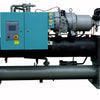
Air-cooled screw chiller
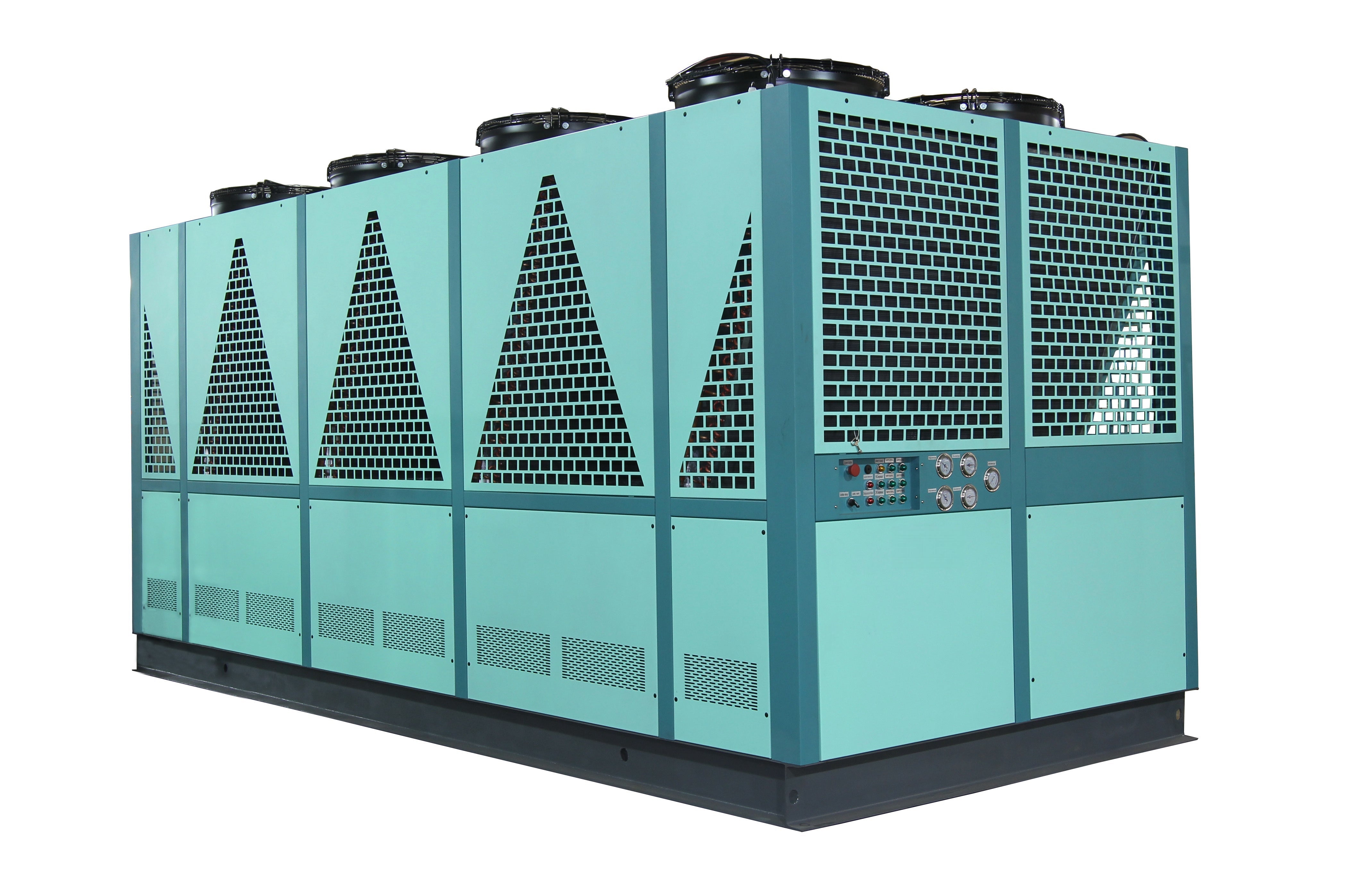
Air-Cooled Screw Chillers: High-Efficiency, Water-Free Cooling for Modern Industrial and Commercial Applications
Abstract
Air-cooled screw chillers have emerged as a leading solution for medium-to-large-scale cooling in water-scarce or space-constrained environments. By integrating robust twin-screw compressors with finned-tube air-cooled condensers, these systems deliver refrigeration capacities from 400 kW to over 2000 kW without requiring cooling towers or water treatment infrastructure. This paper presents a technical review of their vapor-compression cycle, core components—including semi-hermetic screw compressors with built-in oil pressure systems and >99.9% efficient oil separators—and advanced control strategies such as variable-speed drives (VSDs), intelligent defrosting, and multi-stage capacity modulation. Modern units achieve certified COP values exceeding 3.57 under ARI 550/590 standards, operate reliably across ambient temperatures from –11°C to +52°C, and utilize low-ozone-depleting refrigerants like R134a and R407C. Leading models—including YORK YSPA, Gree LM, and McQuay MHS—feature modular stacking, PLC-based temperature control (5–45°C), and comprehensive safety protections. Applications span data centers, hospitals, shopping malls, and industrial processes such as injection molding and pharmaceutical manufacturing. With China’s market projected to reach ¥6.21 billion in 2025 and tightening “dual carbon” policies accelerating adoption of high-efficiency equipment, air-cooled screw chillers represent a strategic enabler of sustainable, resilient thermal management.
Keywords: air-cooled screw chiller; twin-screw compressor; COP; R134a; oil separator; modular design; industrial cooling
1. Introduction
As global industries prioritize operational resilience, energy efficiency, and water conservation, air-cooled screw chillers have gained prominence as a self-contained, high-capacity cooling solution. Unlike water-cooled systems that depend on cooling towers and continuous water supply, air-cooled units reject heat directly to ambient air—making them ideal for rooftops, remote sites, or regions facing water stress [1][10].
Their rise is further driven by stringent environmental regulations, digitalization of building systems, and the expansion of energy-intensive sectors like data centers and lithium battery manufacturing. In China alone, the air-cooled screw chiller market grew by 6.2% in 2024, reaching ¥5.83 billion, with projections of ¥6.21 billion in 2025 [3]. This paper synthesizes current technical specifications, innovations, and deployment trends based on industry data up to early 2026.
2. System Architecture and Working Principle
An air-cooled screw chiller operates on the standard vapor-compression refrigeration cycle, enhanced by the positive displacement action of a twin-screw compressor:
- Compression: Low-pressure refrigerant vapor enters the semi-hermetic twin-screw compressor, where intermeshing rotors compress it into high-pressure, high-temperature gas. Advanced models use built-in oil pressure systems—eliminating external oil pumps—while maintaining optimal lubrication [1][6].
- Condensation: The hot gas flows into an air-cooled condenser composed of copper-aluminum finned tubes. Axial fans force ambient air across the coils, rejecting heat and condensing the refrigerant into liquid.
- Expansion: The liquid passes through an electronic expansion valve (EEV) or thermostatic valve, reducing pressure and temperature.
- Evaporation: In the shell-and-tube evaporator, the cold refrigerant absorbs heat from the chilled water loop (typically 5–15°C), completing the cycle [1][6].
This closed-loop design enables plug-and-play installation with minimal civil works—critical for retrofit projects or temporary facilities.
3. Core Technical Features
3.1 High-Efficiency Twin-Screw Compressor
Modern units employ 5:6 asymmetric rotor profiles, achieving 20–30% higher efficiency than reciprocating compressors [6]. Key innovations include:
- Multi-stage capacity control (e.g., 100%–75%–50%–25% or continuous modulation),
- 11-bearing design with axial thrust balance drums, extending bearing life by 2.5–3.5×,
- Integrated oil management: Oil separators combining cyclone, inertial collision, and adsorption achieve oil separation efficiency of 99.97% [1].
3.2 Performance Metrics
- Cooling capacity: 400–1570 kW standard; up to 2000 kW via modular stacking (e.g., Gree LM series) [1][6].
- COP: ≥3.57 (refrigeration); ≥3.66 (heating mode in heat pump variants) [1].
- Operating range: Ambient –11°C to +52°C; chilled water 5–45°C [1][9].
- Refrigerants: Primarily R134a and R407C—zero ODP, moderate GWP, non-flammable [1][6].
3.3 Intelligent Control & Safety
PLC-based controllers enable:
- Precise temperature regulation (±0.5°C),
- Automatic defrost logic,
- Multi-layer protection: high/low pressure, phase loss, freeze prevention, motor overload [1][10].
Noise levels are typically <75 dB(A), suitable for urban rooftops [10].
4. Leading Product Platforms (as of 2026)
| Brand & Series | Key Features | Application Focus |
|---|---|---|
| YORK YSPA | 400–1570 kW; R134a; COP=3.57; –11°C to 52°C operation | Large commercial buildings (malls, hospitals) [1] |
| Gree LM | Modular design; no master-sub module; shell-tube anti-freeze heating; intelligent defrost | Flexible scalability for industrial parks [1][6] |
| McQuay MHS | Medical-grade reliability; requires annual maintenance (oil/filter replacement, electrical checks) | Hospitals, labs, cleanrooms [1][11] |
Other common models (e.g., SJ-100AS) offer semi-hermetic compressors, multiple refrigerant options, and standardized safety protocols [1].
5. Applications Across Sectors
- Data Centers: Rapidly growing segment; units provide stable 24/7 cooling for server racks without water dependency [1][8]. Alibaba and Tencent deploy these in regional hubs [8].
- Commercial Buildings: Malls, offices, and hotels benefit from rooftop installation and low operating costs [4].
- Healthcare: MRI/CT scanners and vaccine storage require uninterrupted, precise cooling—met by McQuay and YORK units [1][11].
- Industrial Processes: Injection molding, chemical reactors, and electronics manufacturing leverage ±0.5°C stability and corrosion-resistant circuits [1][10].
A real-world case: a 6-unit YORK YSPA installation on a shopping mall rooftop reduced electricity bills by ~22% while maintaining 24°C indoor comfort [4].
6. Market Trends and Sustainability Outlook
Despite an overall decline in the broader screw chiller market, air-cooled variants show relative resilience due to demand from data centers, new commercial construction, and government-mandated equipment upgrades under China’s “dual carbon” policy [1][3].
Key drivers include:
- Policy support: Mandatory procurement of Tier-1 energy-efficient equipment in public projects [5].
- Localization: Domestic brands (Gree, Midea, Hanbell) now rival international players in performance and cost [3].
- Emerging applications: 5G base stations, EV battery plants, and cold-chain logistics are expanding the addressable market [3].
However, challenges remain—higher upfront cost vs. scroll chillers, noise sensitivity, and lower COP than water-cooled counterparts in hot climates.
7. Future Directions
Innovation is focused on:
- Hybrid natural cooling: Leveraging ambient dry-bulb depression for free cooling during cool seasons [8].
- AI-driven optimization: Real-time adjustment of fan/compressor speed based on load and weather (validated to save 9.6% annual energy via CLS + CTC strategies) [2].
- Next-gen refrigerants: Pilots with R1234ze (GWP <1) underway, though flammability and cost remain barriers [5].
Modular, IoT-enabled, and service-integrated designs will dominate next-generation offerings.
8. Conclusion
Air-cooled screw chillers combine mechanical robustness, operational simplicity, and rising intelligence to meet the evolving demands of modern cooling. By eliminating water dependency, delivering high part-load efficiency, and supporting rapid deployment, they offer a compelling alternative in both industrial and commercial settings. As sustainability mandates intensify and digital infrastructure expands, these systems will play an increasingly vital role in building climate-resilient, energy-smart facilities worldwide.
-
Đăng trong
Industrial chiller