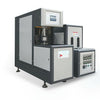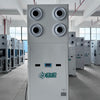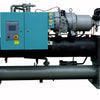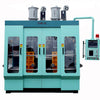
Water-cooled screw-type chiller

1. Introduction
As global manufacturing intensifies and sustainability regulations tighten, the demand for reliable, energy-efficient cooling has never been greater. Among all chiller types, water-cooled screw-type industrial chillers stand out for their ability to deliver high cooling capacity (typically 100–2000 RT), exceptional part-load efficiency, and long service life (>20 years) under 24/7 operation [1][3].
Widely deployed in injection molding plants, biopharmaceutical reactors, laser cutting systems, and semiconductor cleanrooms, these chillers use a closed-loop water circuit connected to a cooling tower to reject heat—decoupling performance from ambient temperature fluctuations [4]. With China accounting for over 35% of global production and domestic brands gaining international recognition, water-cooled screw chillers are at the forefront of the green industrial revolution [7].
2. Working Principle and System Architecture
A water-cooled screw chiller operates on the vapor-compression refrigeration cycle, enhanced by the positive displacement action of a twin-screw compressor:
- Compression: Low-pressure refrigerant vapor enters the semi-hermetic twin-screw compressor, where intermeshing male and female rotors compress it to high pressure and temperature with minimal pulsation and vibration.
- Condensation: Hot gas flows into a shell-and-tube water-cooled condenser, where cooling tower water absorbs heat, condensing the refrigerant into liquid.
- Expansion: The high-pressure liquid passes through an electronic expansion valve (EEV), precisely metered based on evaporator load.
- Evaporation: In the flooded or dry evaporator, the cold refrigerant absorbs heat from the chilled water loop (typically 7/12°C), producing stable process cooling before returning to the compressor [1][5].
This configuration enables high volumetric efficiency, smooth operation, and excellent turndown capability—critical for variable-load applications.
3. Core Components and Performance Advantages
| Component | Key Features | Performance Impact |
|---|---|---|
| Twin-Screw Compressor | Semi-hermetic design; oil-injected lubrication; VSD compatibility | COP up to 6.5; IPLV >9.0; low maintenance vs. centrifugal units |
| Shell-and-Tube Heat Exchangers | Enhanced copper tubes; counter-flow design | 15–20% higher heat transfer vs. plate exchangers |
| Refrigerant | R134a (GWP=1430), R513A (GWP=573), transitioning to R1234ze (GWP<1) | Balances efficiency, safety, and environmental compliance |
| Control System | PLC + HMI; Modbus/BACnet communication; cloud connectivity | Enables remote monitoring, fault diagnosis, and energy reporting |
Compared to scroll or reciprocating chillers, screw-type units offer:
- Higher capacity per footprint,
- Superior part-load efficiency (thanks to slide-valve or VSD modulation),
- Longer lifespan due to fewer moving parts and balanced forces [1][4].
4. Technological Innovations (2020–2026)
4.1 Variable-Speed Drives (VSDs)
Over 60% of new mid-to-large screw chillers in China now feature VSDs, allowing compressors to match load in real time—reducing energy consumption by 20–35% at partial loads [7]. Hanbell’s latest VSD models achieve IPLV values of 9.8, exceeding ASHRAE Standard 90.1-2022 requirements [2].
4.2 Large ΔT Operation
By increasing chilled water temperature difference (e.g., from 5°C to 8–10°C), flow rates and pump power drop dramatically. Studies show pump energy savings of 25–30% without compromising cooling capacity—enabled by optimized evaporator design and advanced EEV control [6].
4.3 Low-GWP Refrigerants
Driven by the Kigali Amendment and EU F-Gas Regulation, manufacturers are rapidly adopting R513A and piloting R1234ze. While R134a remains dominant due to its non-flammability and proven reliability, next-gen models are being designed for seamless refrigerant transitions [3][7].
4.4 Intelligent Operation & Maintenance
Brands like Dawoxi and Gree integrate IoT sensors and cloud platforms for:
- Real-time COP monitoring,
- Predictive failure alerts (e.g., oil degradation, bearing wear),
- Automatic defrost and anti-freeze protection [4][7].
This reduces unplanned downtime by up to 40% and extends equipment life.
5. Industrial Applications
| Industry | Application | Chiller Requirements |
|---|---|---|
| Plastics | Injection/blow molding | ±0.5°C stability; rapid cooldown; 24/7 reliability |
| Pharmaceuticals | Fermentation, lyophilization | ±0.1°C precision; cleanroom compatibility; validation support |
| Electronics | Laser marking, PCB etching | Low vibration; corrosion-resistant water paths |
| Data Centers | Server rack cooling | High IPLV; N+1 redundancy; remote management |
| Chemical Processing | Reactor temperature control | Explosion-proof options; stainless steel components |
In one case, a medical device manufacturer using a Fusheng 500 RT water-cooled screw chiller reported 18% lower energy costs and zero thermal-related production stops over 18 months [3].
6. Market Landscape and Sustainability Outlook
China is both the largest producer and consumer of industrial screw chillers. Leading domestic players include:
- Hanbell (Shanghai): Global leader in screw compressor technology, supplying OEMs worldwide.
- Fusheng (Taiwan/China): Known for high-reliability, heavy-duty units.
- Gree & Midea: Integrating chillers into smart factory ecosystems.
- Dawoxi (Shenzhen): Specializing in compact, high-precision models for electronics and lasers [7].
Government policies—including China’s 14th Five-Year Plan for Energy Efficiency and subsidies for Tier-1 equipment—are accelerating adoption of high-COP, low-GWP chillers. Water recycling in closed-loop systems further minimizes environmental impact, countering misconceptions about “high water use.”
7. Challenges and Future Directions
Despite their advantages, challenges include:
- Higher initial cost vs. air-cooled units,
- Dependence on cooling towers (requiring water treatment),
- Need for skilled commissioning and maintenance.
Future trends point toward:
- Hybrid chillers combining screw compression with magnetic bearing or CO₂ cycles,
- Digital twins for lifecycle performance simulation,
- Grid-interactive operation supporting demand-response programs,
- Full refrigerant phase-out plans aligned with 2030 climate targets.
8. Conclusion
Water-cooled screw-type industrial chillers embody the convergence of mechanical excellence, digital intelligence, and environmental responsibility. By delivering unmatched efficiency, reliability, and scalability, they empower industries to meet rising thermal demands while advancing decarbonization goals. As global manufacturing embraces net-zero commitments, these systems will remain foundational to sustainable industrial infrastructure for decades to come.
-
Đăng trong
Industrial chiller