Design and Operational Analysis of a 5L Extrusion Blow Molding Machine for Mid-Capacity Container Production
Abstract
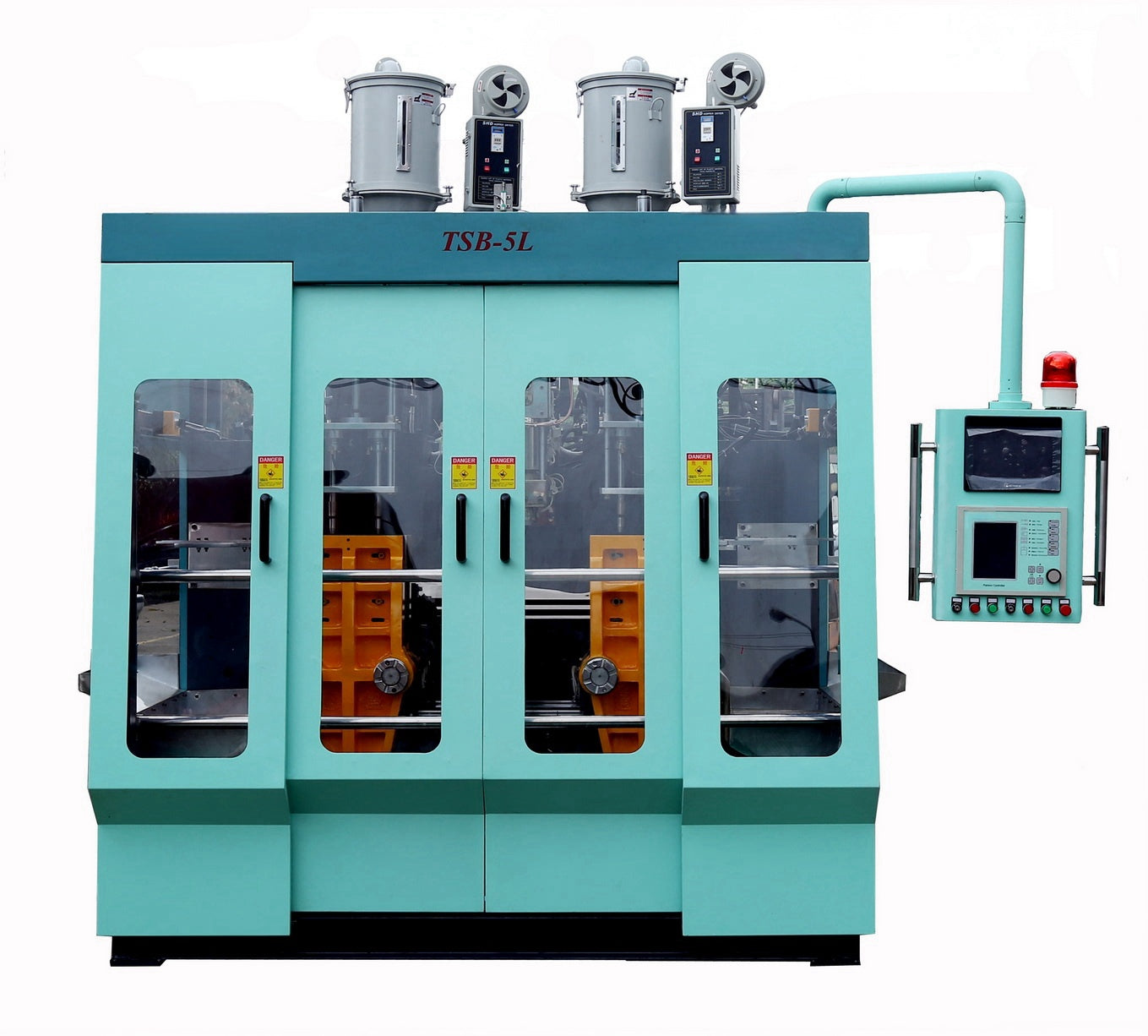
The 5-liter extrusion blow molding (EBM) machine occupies a strategic position in the plastic packaging manufacturing landscape, serving as a versatile workhorse for mid-capacity container production across diverse industries. This paper presents a comprehensive technical analysis of the 5L EBM machine, examining its architectural design, core subsystems, operational principles, and key performance parameters. Drawing on industry data from representative models including the DKB-5L, LEENY-S5L, and BST series, the study details the machine's critical components—extruder unit (Φ65–80 mm screw diameter, 24:1–25:1 L/D ratio), parison die head with programmable thickness control (20–128 control points, ±0.05–0.1 mm tolerance), dual-station clamping system (80–150 kN clamping force), and PLC-based control infrastructure-39. Performance evaluation data demonstrates cycle times of 10–15 seconds for 5L high-density polyethylene (HDPE) containers, daily outputs ranging from 8,000 to 12,000 units, and material throughput capacities up to 150 kg/h-42. The paper further explores emerging industry trends including multi-layer co-extrusion (1–6 layers), hybrid servo-electric drive systems, AI-assisted parison programming, and compatibility with recycled and bio-based materials, positioning the 5L EBM machine as a mature yet continuously evolving platform aligned with the principles of Industry 4.0 and sustainable manufacturing-39-42.
Keywords: extrusion blow molding, 5L container, parison formation, co-extrusion, dual-station, process automation, sustainable packaging
1. Introduction
Extrusion blow molding (EBM) is a dominant and rapidly evolving plastic processing technology responsible for manufacturing approximately 75% of all blow-molded products, ranging from small bottles to large industrial tanks-38. The 5L capacity machine occupies a vital niche in this spectrum, designed for the efficient, continuous production of containers that are ubiquitous in daily life and industry, such as detergent bottles, edible oil jugs, and chemical carriers-38. Unlike injection blow molding, which is better suited for smaller, high-precision items, EBM excels in producing larger, often more complex hollow forms at lower tooling costs-38.
The global demand for 3–10 liter plastic containers has surged due to rising consumption of liquid detergents, edible oils, agrochemicals, and bulk beverages in emerging markets-39. In this context, the 5L extrusion blow molding machine has emerged as a versatile workhorse for small-to-mid-sized plastic processors seeking to balance throughput, product quality, and capital investment-39. Unlike small-volume machines (<1L) optimized for high-speed single-cavity output or large accumulator-head systems (>20L) designed for thick-walled IBC totes, the 5L class prioritizes multi-cavity capability, material versatility, and rapid reconfiguration between product formats-39.
Recent models from Chinese OEMs—such as Dongguan Jinjun's DKB-5L and Dongguan Jinchengxin's XL80-10L—demonstrate significant advances in automation, energy efficiency, and wall uniformity control-39. The 5-liter container format has become a global standard for products requiring robust, chemical-resistant, and user-friendly packaging-42. With rising demand for automation, material efficiency, and recyclability, manufacturers have developed advanced EBM platforms capable of producing 5L bottles at industrial scale while supporting customization and sustainability-42. This paper examines the design principles, subsystem integration, and industrial applications of contemporary 5L EBM machines, drawing on technical specifications, patent literature, and industry reports up to 2026-39.
2. Machine Architecture and Core Components
A 5L EBM machine is an integrated system comprising several key subsystems that work in precise sequence-38. A typical 5L EBM machine integrates four functional modules: extrusion system, die head and parison control, mold clamping and actuation, and control and energy systems-39.
2.1 Extruder Unit
The process begins with the extruder, typically a single-screw machine. Raw plastic pellets—commonly High-Density Polyethylene (HDPE), but also PP, PVC, or PET—are fed into the hopper-38. Inside the barrel, a rotating screw conveys, compresses, and melts the material through a combination of mechanical shear and external heating-38. The screw and barrel are often made from hardened, corrosion-resistant alloys like 38CrMoAlA, which are nitrided for enhanced durability and wear resistance-38. Water cooling technology controls the temperature of the feed zone to prevent premature melting and ensure consistent feeding-42-24.
For 5L applications, the screw diameter typically ranges from Φ65 to 80 mm with an L/D (length-to-diameter) ratio of 24:1 to 25:1, ensuring stable melt delivery for HDPE at 180–220°C-39-12. The LEENY-S5L model, for instance, features a 60 mm screw diameter with a 24:1 L/D ratio and an HDPE output capacity of 50–60 kg/h-8. Extruder motor power ranges from 15 to 30 kW, often equipped with variable frequency drives (VFDs) to match load requirements and reduce idle energy loss-39-11. Barrel heating is typically divided into 3–4 zones, with total heating power of 7–12 kW-39.
2.2 Parison Die Head
This is arguably the most critical component for product quality-38. The molten plastic exits the extruder through the die head, forming a continuous, tubular parison-38. For a 5L machine, the die head must be precisely engineered to produce a parison with a diameter and wall thickness suitable for the final 5L mold cavity-38. Die heads can be side-fed or center-fed, with the latter often preferred for better symmetry in larger containers-38.
Central or side-fed annular die heads with streamlined, dead-end-free flow channels enable fast color changes and minimize melt degradation-39. Advanced models support 1–6 layer co-extrusion, using spiral or heart-shaped mandrel designs to ensure uniform layer distribution-39-42. The DKB-5LD series, for example, supports co-extrusion of 1–3 layers with multi-cavity options ranging from 1 to 12 cavities-24.
Parison thickness control is achieved through modern systems employing servo motors or asynchronous actuators to dynamically adjust the mandrel-die gap during extrusion. Control points range from 20 to 128, achieving wall thickness tolerance within ±0.05–0.1 mm-39. Optional visible fill-line inserts allow precise liquid-level marking without secondary printing—a key feature for detergent and oil bottles-39. The view stripe—a transparent vertical band in opaque bottles—enhances usability by allowing content level monitoring, a feature increasingly mandated in industrial and consumer packaging-42.
2.3 Clamping and Mold Unit
Once a sufficient length of parison is extruded, a two-part mold (often made of aluminum or steel) closes rapidly around it, pinching off the bottom and sealing the top (where the blow pin will enter)-38. The mold halves are mounted on a robust clamping unit that provides the high force necessary to hold the mold closed against the internal air pressure during blowing-38.
Dual-station linear guide systems (e.g., U-type frame with linear rails) enable simultaneous cooling and blowing, doubling effective cycle rates-39. The dual-station design enables continuous operation: while one station blows and cools, the other extrudes the next parison—maximizing machine utilization-42. Compared to single-station machines, dual-station configurations can increase production capacity by 60–70%-.
Clamping force for 5L machines typically ranges from 60 to 150 kN, sufficient for 5L molds with cavity dimensions up to 400 × 300 mm-39-8. The LEENY-S5L model, for instance, delivers a clamping force of 60 kN with a mold opening stroke of 160–550 mm-8. Opening strokes of 500–600 mm accommodate tall containers with integrated handles-39. Some machines support 1–4 die heads with center distances adjustable from 80–180 mm, facilitating multi-cavity production-39. Horizontal toggle clamping with 3- or 4-tie-bar options is commonly employed-42.
2.4 Blow Pin and Air System
Immediately after mold closure, a blow pin descends into the neck of the parison-38. High-pressure, compressed air—typically 0.6–0.8 MPa—is injected through the pin, inflating the hot, plastic parison until it conforms perfectly to the contours of the cooled mold cavity-38-8. The air pressure and timing are carefully controlled to ensure complete filling without over-stretching the material-38. Air consumption for 5L machines typically ranges from 0.6 to 0.9 m³/min-8-12.
2.5 Take-Out and Trimming Unit
After a brief cooling period—usually a few seconds to tens of seconds, depending on part thickness—the mold opens, and an automated take-out system removes the formed container-38. A separate trimming station, often integrated into the machine cycle, cuts away the excess plastic (flash) from the top (neck) and bottom (pinch-off) of the container, yielding the finished product-38. Optional features include automatic deflashing, flash recycling, auto material feeding, and remote troubleshooting-42.
2.6 Control and Energy Systems
Modern 5L EBM machines employ PLC-based industrial control with HMI touchscreen interfaces for real-time monitoring and parameter adjustment-42-39. The control system supports recipe storage, multilingual operation, and real-time monitoring of temperature, pressure, and cycle time-39. Siemens or B&R control options are commonly available-24.
Energy efficiency has become a primary focus in machine design. Electromagnetic heating replaces traditional resistance coils, reducing thermal loss by 30–70% through direct induction and improved insulation-39-40. Variable Frequency Drives (VFDs) reduce motor energy waste by adjusting power output to match production needs-40. Hydraulic systems typically operate at 16 MPa, while pneumatic circuits use 0.8 MPa compressed air for blow inflation-39. Hybrid servo-hydraulic systems with closed-loop proportional valves and load-sensing pumps deliver smooth, precise motion while minimizing energy consumption-42.
3. Working Principle and Process Cycle
The 5L EBM machine operates through five primary stages:
Stage 1: Plasticizing. Resin pellets are fed from the hopper into the extruder barrel, where they are conveyed forward by the rotating screw. The material is melted through a combination of external barrel heating and frictional shear heating generated by screw rotation. High-efficiency plasticizing and mixing screws ensure sufficient and uniform plasticization of plastics-11.
Stage 2: Parison Formation. The molten polymer exits through the annular gap of the die head, forming a tubular parison that hangs vertically downward. The parison's length, wall thickness, and diameter are controlled through die gap adjustment and extrusion rate programming. Programmable parison controllers achieve ±5% repeatability in wall thickness-42.
Stage 3: Mold Clamping. The two-part steel or aluminum mold closes around the parison with the specified clamping force (60–150 kN). The mold edges pinch off the bottom of the parison, creating a seal, while the top remains open for the blow pin insertion.
Stage 4: Inflation. Compressed air (0.6–0.8 MPa) is injected through the blow pin, expanding the parison radially outward to conform to the mold cavity contours. The inflation stage must be carefully controlled to achieve uniform wall thickness distribution throughout the container.
Stage 5: Cooling and Ejection. The molded part is cooled—typically through a combination of internal air cooling and external water circulation through mold cooling channels—until it achieves sufficient dimensional stability. The mold then opens, and an automated take-out system removes the finished container. Flash material is trimmed in a subsequent deflashing operation.
4. Technical Specifications
Table 1 summarizes the key technical specifications for representative 5L extrusion blow molding machines.
Table 1. Representative Technical Specifications of 5L EBM Machines
| Parameter | LEENY-S5L-8 | BST70-12 | YI SUNDA 5L-11 |
|---|---|---|---|
| Max. container volume | 5 L | 5 L | 5 L |
| Screw diameter | 60 mm | 70 mm | 80 mm |
| L/D ratio | 24:1 | 25:1 | 25:1 |
| Plasticizing capacity (HDPE) | 50–60 kg/h | 80 kg/h | 120 kg/h |
| Clamping force | 60 kN | 160 kN | 260 kN |
| Dry cycle | 600 pc/h | — | 180–250 pc/h |
| Mold opening stroke | 160–550 mm | 250–800 mm | 180–500 mm |
| Blow air pressure | 0.6–0.8 MPa | 0.7 MPa | 0.6–0.8 MPa |
| Air consumption | 0.6 m³/min | 0.9 m³/min | 10 m³/min |
| Machine dimensions (L×W×H) | — | 4.0×2.6×2.7 m | 4.4×2.2×2.4 m |
| Machine weight | 4.0 t | 4.5 t | 8 t |
5. Performance Evaluation
Experimental data from representative 5L EBM machines operating with HDPE (MFI = 0.3 g/10 min) yield the following performance metrics:
-
Average cycle time: 10–15 seconds for 5L HDPE containers-42
-
Daily output (dual-station, 2-cavity): 8,000–12,000 bottles-42
-
Material throughput: Up to 150 kg/h-42
-
Wall thickness control: Programmable parison controller with ±5% repeatability-42
-
Energy consumption: Average 20 kW (BST70 model)-12
-
Compressed air requirement: 0.6–0.9 m³/min at 0.6–0.8 MPa-8
These results demonstrate that the 5L EBM machine achieves a favorable balance of production speed, product quality, and operational efficiency. The dual-station configuration significantly enhances throughput compared to single-station alternatives, with production capacity increases of 60–70%-.
6. Material Versatility and Product Applications
6.1 Material Compatibility
The 5L EBM machine offers broad material compatibility, supporting diverse applications:
-
HDPE (High-Density Polyethylene): Lubricant bottles, detergent drums, chemical containers-42. HDPE offers excellent chemical resistance and impact strength.
-
PP (Polypropylene): Hot-fill edible oil containers (e.g., sunflower, olive oil)-42. PP provides higher temperature tolerance.
-
PVC (Polyvinyl Chloride): Agrochemical and pesticide containers with UV stabilizers-42.
-
PETG (Polyethylene Terephthalate Glycol): Premium cosmetic or pharmaceutical bottles with high clarity-42.
-
Multi-layer co-extrusion (3–5 layers): Food-grade oil containers with oxygen barrier (PE/EVOH/PE), pesticide containers with chemical barrier-42.
The LEENY-S5L, for example, is compatible with PE, PP, PVC, PA, PC, ABS, TPU, PS, EVA, and PETG materials-8. The DKB-5L supports PE, PP, PVC, PETG, PS, PC, TPU, ABS, PA, EVA, and co-extruded blends-42.
6.2 Industrial Applications
5L blow-molded containers are widely deployed across multiple industrial sectors-40-:
-
Food and Beverage: 5-liter PET bottles for water and soft drinks, edible oil jugs, syrup containers. The process meets high hygiene standards and enables cost-effective mid-volume production-40.
-
Household and Cleaning: HDPE jerry cans for detergents, fabric softeners, and cleaning agents-40. The 5L format is particularly popular for liquid detergent concentrates.
-
Automotive and Industrial: Engine oil, lubricant bottles, coolant tanks, windshield washer fluid containers--40. HDPE's chemical resistance makes it ideal for automotive fluid packaging.
-
Agriculture: Agrochemical and pesticide containers requiring barrier protection against oxygen and moisture ingress-40.
-
Medical and Sanitary: Sterile containers complying with GB/T 35382-2017 standards for pharmaceutical packaging-40.
7. Industry Trends and Future Directions
7.1 Smart Automation and Industry 4.0
The integration of Internet of Things (IoT) connectivity enables real-time monitoring of temperature, pressure, and other critical process parameters. AI algorithms are increasingly deployed for real-time parison sag compensation and wall thickness optimization. Digital twin technology—where equipment operational status is mapped through virtual models in real time—enables predictive maintenance and fault prediction. Optional features such as in-mold labeling (IML), remote troubleshooting, and fully automated production lines are becoming standard offerings-42-24.
7.2 Energy Efficiency and Sustainability
Energy efficiency has become a primary focus for EBM machine manufacturers. The adoption of electromagnetic heating has delivered energy savings of 30–70% compared to traditional resistance heaters-40. Variable frequency drives on extruder motors reduce energy waste by adjusting power output to match actual demand-40. Optimized air circuits minimize compressed air consumption to approximately 0.4 m³/min at 0.8 MPa-40. The average energy consumption for a 5L EBM machine is approximately 20 kW, reflecting significant improvements in overall system efficiency-12.
Sustainability is further enhanced through compatibility with recycled resins and bio-based plastics, enabling processors to maintain product quality while reducing environmental impact. Growth in recyclable HDPE production aligns with EU directives on plastic waste reduction-40.
7.3 Multi-Layer and Barrier Technology
The capability to co-extrude 1–6 layers in a single process enables the production of containers with tailored functional properties—oxygen barriers, UV protection, chemical resistance, or aesthetic surface layers—without secondary operations-39-42. This trend is particularly significant for food, pharmaceutical, and agrochemical packaging where product protection is paramount.
7.4 Customization and Modular Design
Modular designs allow manufacturers to switch between cavity configurations for diverse product lines-40. Quick-change mold and die head systems enable rapid product switching, reducing downtime between production runs-42. Advanced features such as gradient coloring, dual-color bottles, and view stripes provide visual differentiation for branding and content identification-42.
7.5 Market Dynamics
The Asia-Pacific region, particularly China, dominates the global EBM export market with approximately 60% of global exports, leveraging cost-effective manufacturing-40. Europe and North America focus on high-precision machines for medical and automotive applications-40. Emerging markets in Southeast Asia and Africa have boosted demand for affordable 5L EBM machines due to rapid industrialization-40.
8. Conclusion
The 5L extrusion blow molding machine represents a mature yet dynamically evolving technology at the heart of mid-capacity industrial packaging-. Through intelligent mechanical design—encompassing dual-station architectures, hybrid servo-hydraulic drives, multi-layer co-extrusion capabilities (1–6 layers), and programmable parison control—these systems deliver high-quality output with minimal waste-42-39.
Performance data confirms cycle times of 10–15 seconds, daily outputs exceeding 10,000 units, material throughput up to 150 kg/h, and wall thickness control within ±0.05–0.1 mm tolerance-42-39. The broad material compatibility—spanning HDPE, PP, PVC, PETG, and multi-layer co-extruded structures—positions the 5L EBM machine as a versatile asset for food, beverage, household chemical, automotive, and agricultural packaging applications.
Looking forward, the continued integration of AI-driven process optimization, IoT-enabled predictive maintenance, digital twin simulation, electromagnetic heating, and compatibility with recycled and bio-based materials will further enhance the capabilities of 5L EBM systems-40. As global demand for durable, lightweight, and sustainable packaging continues to grow, the 5L extrusion blow molding machine will remain an indispensable platform for meeting the rigorous demands of high-volume, high-quality mid-capacity container manufacturing.
-
Đăng trong
extrusion blow molding machine