Design and Operational Analysis of a 2.5L Extrusion Blow Molding Machine for Medium-Sized Container Production
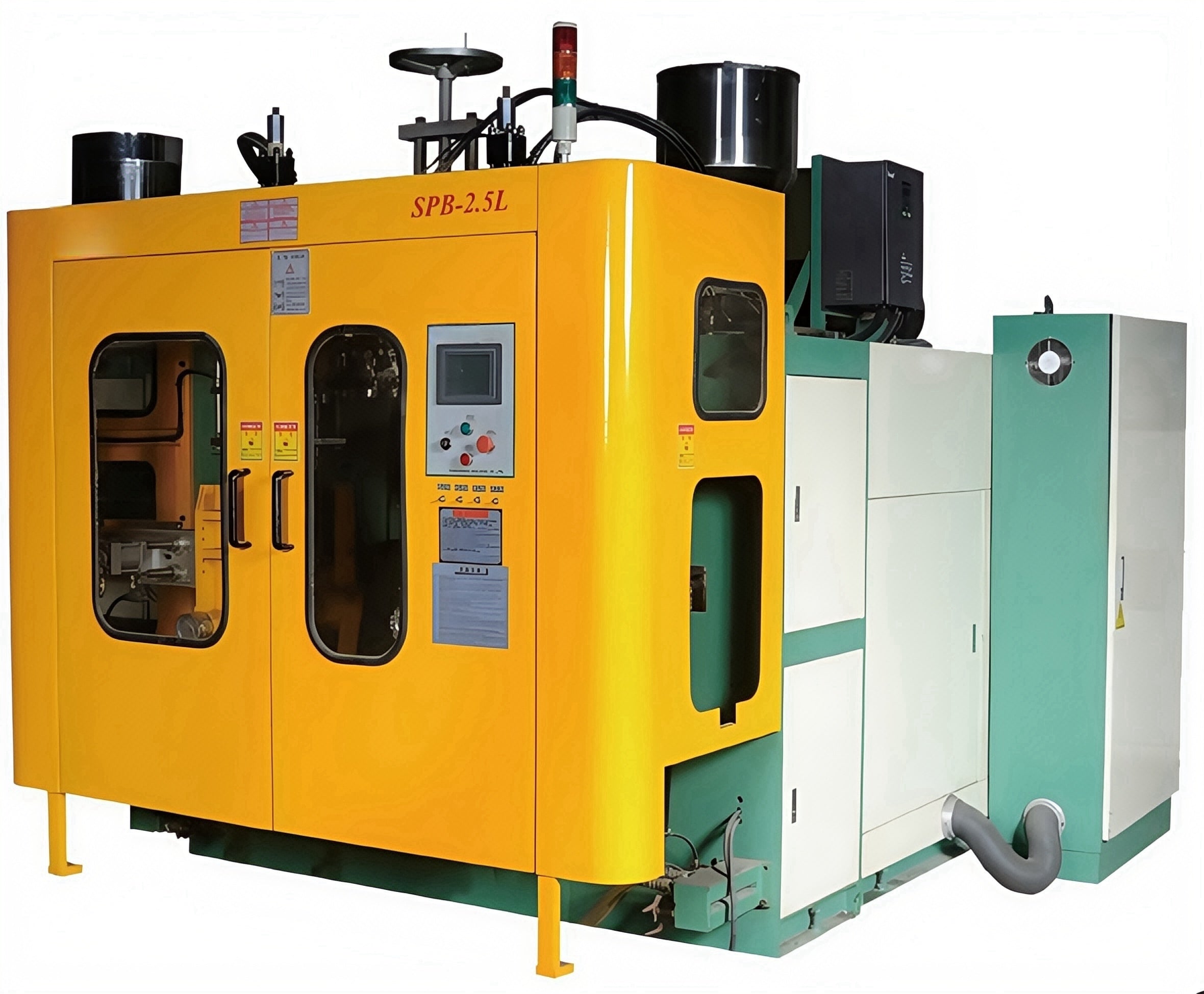
Abstract
The 2.5-liter extrusion blow molding (EBM) machine represents a critical technological solution in the mid-capacity container manufacturing sector, bridging the gap between high-speed small-bottle production and large-vessel blow molding systems. This paper presents a comprehensive technical analysis of the 2.5L EBM machine, examining its architectural design, operational principles, key performance parameters, and industrial applications. Drawing on industry-standard models including the DKB-2.5L2JUWD and MKB-2.5L series, the study details the machine's core components—extruder unit, parison die head, clamping system, blow pin assembly, and control infrastructure—alongside their respective specifications. Performance evaluation data demonstrates cycle times of 8–12 seconds for 2.5L high-density polyethylene (HDPE) containers, daily outputs ranging from 6,000 to 15,000 units, and energy consumption averaging 1.9 kWh per 100 bottles-8-5. The paper further explores emerging industry trends including hybrid servo-electric drives, AI-assisted parison programming, digital twin technology, and multi-layer co-extrusion capabilities, positioning the 2.5L EBM machine as a mature yet evolving platform aligned with the principles of Industry 4.0 and sustainable manufacturing.
Keywords: extrusion blow molding, 2.5L container, parison formation, co-extrusion, process automation, Industry 4.0
1. Introduction
Extrusion blow molding (EBM) is a dominant manufacturing process for producing hollow plastic articles, ranging from small medical vials to large industrial tanks-6. The process involves extruding molten thermoplastic through an annular die to form a tubular parison, which is then inflated within a closed mold cavity using compressed air to assume the desired container geometry-. Among the various capacity classes of EBM equipment, the 2.5L category occupies a vital middle ground, specifically engineered for the efficient, high-throughput production of containers that are too large for ultra-high-speed small-bottle machines yet require faster cycles and lower tooling costs than machines designed for very large vessels-6.
The 2.5L format has emerged as a key standard in industrial and consumer packaging, balancing ergonomic handling, logistical efficiency, and product visibility-5. Containers of this capacity are ubiquitous in applications ranging from premium cooking oils and detergent concentrates to lubricants, agrochemicals, and beverage products-5-8. Unlike injection molding or injection stretch blow molding, extrusion blow molding excels in producing seamless, stress-free containers with integrated handles and variable wall thickness, particularly in the 2–5L range-5.
Recent advancements in machine design—including dual-station configurations, multi-layer co-extrusion capabilities, hybrid drive systems, and intelligent process controls—have elevated 2.5L EBM systems to new levels of speed, precision, and flexibility-5. This paper provides a systematic technical analysis of the modern 2.5L extrusion blow molding machine, examining its mechanical architecture, operational workflow, performance metrics, and alignment with contemporary industry trends.
2. Machine Architecture and Core Components
A 2.5L EBM machine is a complex, integrated system designed for robust, continuous operation. Its design prioritizes stability and high output for medium-sized containers-6. The major subsystems are detailed below.
2.1 Extruder Unit
The heart of the machine is a single-screw extruder that converts raw plastic pellets—typically HDPE, PP, or PETG—into a homogeneous molten polymer melt-12. For a 2.5L machine, a screw diameter of 65–75 mm with an L/D (length-to-diameter) ratio of 24:1 to 25:1 is common, providing sufficient plasticizing capacity for materials like HDPE and PP-6-. The DKB-2.5L2JUWD model, for instance, achieves a plasticizing capacity of approximately 90 kg/h for HDPE--12. The extruder is typically driven by an 11 kW motor and features multiple heating zones—commonly seven zones—with a total heating power of 11–15 kW to ensure precise temperature control and homogeneous melt quality-6.
2.2 Parison Die Head
The molten plastic is extruded through a die head to form the parison—a tube-shaped molten polymer preform. For 2.5L applications, die heads are often designed for single-layer extrusion but can be configured for 2–6 layer co-extrusion to create containers with enhanced barrier properties or aesthetic layers--6. The die head includes its own heating system to maintain melt temperature throughout the extrusion process-6. Center-fed die head designs ensure uniform thickness distribution, reportedly reducing ovality by up to 62%-12. Critical to parison quality is the management of two phenomena: swell due to stress relaxation and sag drawdown due to gravity-. These factors are addressed through precise die geometry design and real-time parison programming.
2.3 Clamping and Mold Unit
This unit provides the force necessary to close the mold and pinch off the parison. A 2.5L machine typically features a hydraulic clamping system with a clamping force ranging from 70 kN to 150 kN, depending on the mold size and number of cavities-12-5-6. The dual-station configuration—exemplified by the DKB-2.5L2JUWD—allows one mold to cool while the other is being filled, effectively doubling throughput and minimizing idle time--6. Mold dimensions are designed to accommodate containers up to 2.5L, with maximum opening distances typically around 430 mm-6.
2.4 Blow Pin and Air System
Compressed air is injected via a blow pin to inflate the parison within the closed mold. Operating pressures typically range from 0.6 to 0.8 MPa-6-12. The air consumption is relatively low—approximately 0.5 m³/min—reflecting the moderate size of the containers-6. Internal air cooling, often supplemented by external water channels in the mold, facilitates rapid solidification of the part before ejection-8.
2.5 Drive and Control System
Modern 2.5L machines employ hybrid drive architectures combining hydraulic power for high-force clamping operations with electric servo motors for precise parison control and auxiliary movements--6. The MKB-2.5L hybrid series, for example, integrates hydraulic mold clamping with servo-driven mold transfer, blow pin actuation, and parison wall thickness control-14. This hybrid approach delivers precise positioning, rapid response, and significant energy savings compared to purely hydraulic systems-14.
The entire process is governed by a Programmable Logic Controller (PLC) with touchscreen human-machine interface (HMI), allowing for precise cycle timing, parameter adjustments, real-time monitoring, and fault diagnostics-5-6. Temperature control accuracy of ±1°C is achievable with modern PLC-based systems-12.
3. Working Principle and Process Cycle
The 2.5L EBM machine operates through five primary stages-8:
Stage 1: Plasticizing. Resin pellets are fed from the hopper into the extruder barrel, where they are conveyed forward by the rotating screw. The material is melted through a combination of external barrel heating and frictional shear heating generated by screw rotation-.
Stage 2: Parison Formation. The molten polymer exits through the annular gap of the die head, forming a tubular parison that hangs vertically downward-8. The parison's length, wall thickness, and diameter are controlled through die gap adjustment and extrusion rate programming.
Stage 3: Mold Clamping. The two-part steel mold closes around the parison with the specified clamping force. The mold edges pinch off the bottom of the parison, creating a seal, while the top remains open for the blow pin insertion-.
Stage 4: Inflation. Compressed air (0.6–0.8 MPa) is injected through the blow pin, expanding the parison radially outward to conform to the mold cavity contours-8. The inflation stage must be carefully controlled to achieve uniform wall thickness distribution throughout the container.
Stage 5: Cooling and Ejection. The molded part is cooled—typically through a combination of internal air cooling and external water circulation through mold cooling channels—until it achieves sufficient dimensional stability-8. The mold then opens, and the finished container is ejected, often with the assistance of a robotic取瓶 mechanism-. Flash material (excess plastic from the parison ends) is trimmed either within the mold or in a subsequent deflashing operation.
4. Technical Specifications
Table 1 summarizes the key technical specifications for representative 2.5L extrusion blow molding machines.
Table 1. Representative Technical Specifications of 2.5L EBM Machines
| Parameter | Specification |
|---|---|
| Max. container volume | 2.5 L (optimized range: 0.5–2.5 L) |
| Screw diameter | 55–75 mm |
| L/D ratio | 24:1 – 25:1 |
| Plasticizing capacity (HDPE) | 40–90 kg/h |
| Clamping force | 70–150 kN |
| Mold cavities | 1–4 cavities |
| Material compatibility | HDPE, PP, PETG, PVC, multi-layer blends |
| Cycle time (2.5L HDPE) | 8–12 seconds |
| Daily output | 6,000–15,000 units |
| Drive type | Hydraulic / Hybrid (hydraulic + servo) |
| Blow air pressure | 0.6–0.8 MPa |
| Control system | PLC with touchscreen HMI |
5. Material and Product Flexibility
The 2.5L EBM machine processes a wide range of thermoplastics, offering manufacturers significant material flexibility-5:
-
HDPE (High-Density Polyethylene): Offers excellent chemical resistance and impact strength, making it ideal for detergent bottles, chemical containers, and automotive fluid packaging-5-8.
-
PP (Polypropylene): Provides higher temperature tolerance (up to 95°C), suitable for hot-fill edible oil containers-5.
-
PETG (Polyethylene Terephthalate Glycol): Delivers high clarity and gloss, preferred for cosmetic and premium oil bottles-5.
-
Multi-layer co-extruded structures: Enable barrier protection (e.g., PE/EVOH/PE constructions) for oxygen-sensitive food products or aggressive chemical contents-5.
Advanced features such as gradient bottle technology—allowing color or material gradients along the bottle height—enable visual differentiation for branding and content identification without post-molding decoration-5-1. The view stripe function integrates transparent vertical bands in otherwise opaque bottles, allowing users to monitor fill levels—a critical feature for industrial and consumer applications-5.
6. Performance Evaluation
Experimental trials using HDPE (MFI = 0.3 g/10 min) over 600 production cycles on a representative 2.5L EBM machine yielded the following performance metrics-8:
-
Average cycle time: 8.7 seconds
-
Bottle weight consistency: ±1.0%
-
Minimum wall thickness: 0.45 mm (base), 0.30 mm (body)
-
Burst pressure: >220 kPa
-
Scrap rate: <1.8%
-
Energy consumption: 1.9 kWh per 100 bottles
These results demonstrate that the 2.5L EBM machine achieves a favorable balance of production speed, product quality, and operational efficiency. The low scrap rate and moderate energy consumption underscore the process's suitability for sustainable, high-volume manufacturing.
7. Industrial Applications
2.5L blow-molded containers are widely deployed across multiple industrial sectors-5-12:
-
Food and Beverage: Premium olive oil, sunflower oil, vinegar, water bottles, and juice jugs. The process meets high hygiene standards and enables cost-effective mid-volume production-5-12.
-
Household and Cleaning: Concentrated detergents, fabric softeners, and cleaning agents. HDPE's chemical resistance makes it ideal for corrosive formulations-5-12.
-
Automotive: Engine oil, transmission fluid, coolant reservoirs, and other lubricant containers-5-12.
-
Agriculture: Agrochemical containers requiring barrier protection against oxygen and moisture ingress-5.
8. Industry Trends and Future Directions
8.1 Smart Automation and Industry 4.0
The integration of Internet of Things (IoT) connectivity enables real-time monitoring of temperature, pressure, and other critical process parameters-12. AI algorithms are increasingly deployed for real-time parison sag compensation, reportedly achieving wall thickness tolerances within ±0.02 mm while reducing energy consumption by 20%-53. Digital twin technology—where equipment operational status is mapped through virtual models in real time—has demonstrated fault prediction accuracy improvements up to 95% and downtime reductions of 40%-53.
8.2 Energy Efficiency
Energy efficiency has become a primary focus for EBM machine manufacturers-. The adoption of servo-electric drives in hybrid machines has delivered energy savings of approximately 30% compared to conventional hydraulic systems, with key component service life extended by 50%-53. Variable frequency drives (VFDs) on hydraulic pumps further reduce energy waste by matching pump output to actual demand, replacing fixed-speed operation-.
8.3 Sustainability and Material Innovation
Manufacturers are increasingly incorporating features to support circular economy goals-8. Enhanced material compatibility now extends to recycled resins and bio-based plastics, enabling processors to maintain product quality while reducing environmental impact-49. Biodegradable materials such as PBAT/PLA blends are achieving commercial viability in blow molding applications-53.
8.4 Multi-Layer and Barrier Technology
The capability to co-extrude 1–6 layers in a single process enables the production of containers with tailored functional properties—oxygen barriers, UV protection, or aesthetic surface layers—without secondary operations--1. This trend is particularly significant for food, pharmaceutical, and agrochemical packaging where product protection is paramount.
9. Conclusion
The 2.5L extrusion blow molding machine represents a mature yet adaptable solution for mid-capacity container production-8. Through intelligent mechanical design—encompassing dual-station architectures, hybrid servo-hydraulic drives, and multi-layer co-extrusion capabilities—and precise process control via PLC-based automation, these systems deliver high-quality output with minimal waste-8. Performance data confirms cycle times under 10 seconds, daily outputs exceeding 10,000 units, scrap rates below 2%, and energy consumption of less than 2 kWh per 100 bottles, positioning the 2.5L EBM machine as a valuable asset in modern plastic packaging facilities-8.
Looking forward, the continued integration of AI-driven process optimization, IoT-enabled predictive maintenance, digital twin simulation, and compatibility with recycled and bio-based materials will further enhance the capabilities of 2.5L EBM systems. As global demand for durable, lightweight, and sustainable packaging continues to grow, the 2.5L extrusion blow molding machine will remain an indispensable platform for meeting the rigorous demands of high-volume, high-quality container manufacturing-5-6.
-
Đăng trong
extrusion blow molding machine