Development and Application of Semi-Automatic PET Stretch Blow Molding Machines: A Comprehensive Review
Development and Application of Semi-Automatic PET Stretch Blow Molding Machines: A Comprehensive Review
Abstract
Polyethylene terephthalate (PET) bottles have become ubiquitous in the packaging industry due to their excellent mechanical properties, transparency, and recyclability. Semi-automatic PET blow molding machines represent a critical segment of the manufacturing equipment market, offering a balanced solution between manual operation and full automation. This paper provides a comprehensive review of semi-automatic PET stretch blow molding machines, covering their working principles, system architecture, process parameters, quality control methodologies, and comparative advantages relative to fully automatic systems. The two-stage reheat stretch blow molding process is examined in detail, including preform heating, stretching, blowing, and cooling operations. Key process parameters—including preform temperature, blow delay time, low-blow duration, and blowing pressure—are analyzed based on recent experimental studies. The paper also discusses common quality defects and their mitigation strategies, presents market trends and economic considerations, and explores future development directions. The findings indicate that semi-automatic machines remain highly relevant for small-to-medium enterprises, startup operations, and applications requiring high flexibility in bottle design and batch size, offering lower capital investment and operational simplicity while maintaining satisfactory product quality when process parameters are properly optimized.
Keywords: PET blow molding, semi-automatic machine, stretch blow molding, two-stage process, process optimization, preform heating
1. Introduction
Polyethylene terephthalate (PET) has emerged as one of the most widely used thermoplastic polymers in the packaging industry, particularly for beverage containers, edible oil bottles, pharmaceutical packaging, and cosmetic products-. The global demand for PET packaging continues to grow, driven by increasing consumption of bottled beverages, the shift toward lightweight packaging, and the material's excellent recyclability-20. Central to the production of PET bottles is the blow molding process, which transforms injection-molded preforms into finished containers through stretching and blowing operations.
Blow molding machines for PET bottle production are broadly categorized into two types: single-stage (one-step) machines and two-stage (two-step) machines-2. In the single-stage process, injection molding of preforms and subsequent blowing are performed within the same machine, offering advantages such as blemish-free bottles and compact footprint-2. However, this approach suffers from longer cycle times and quality challenges associated with thermal-gated hot runners-2. The two-stage process, by contrast, separates preform production from bottle blowing, enabling faster cycle times, greater flexibility, and scalability from 1,000 to 72,000 bottles per hour-2.
Within the two-stage category, machines are further classified as fully automatic or semi-automatic. Semi-automatic PET blow molding machines occupy a distinct market position, characterized by a partnership between human operators and automated machinery-27. These machines typically require operators to manually load preforms into the heating oven, transfer heated preforms to the blow mold, and remove finished bottles-14. While the blowing and stretching operations themselves are automated and controlled by programmable logic controllers (PLCs), human intervention remains essential at key stages of the production cycle-.
This paper aims to provide a systematic review of semi-automatic PET blow molding machine technology, covering machine architecture, process principles, critical parameters, quality considerations, and market positioning. The review synthesizes information from equipment manufacturers, experimental studies, and industry reports to present a comprehensive understanding of this important manufacturing technology.
2. Machine Architecture and Working Principles
2.1 System Components
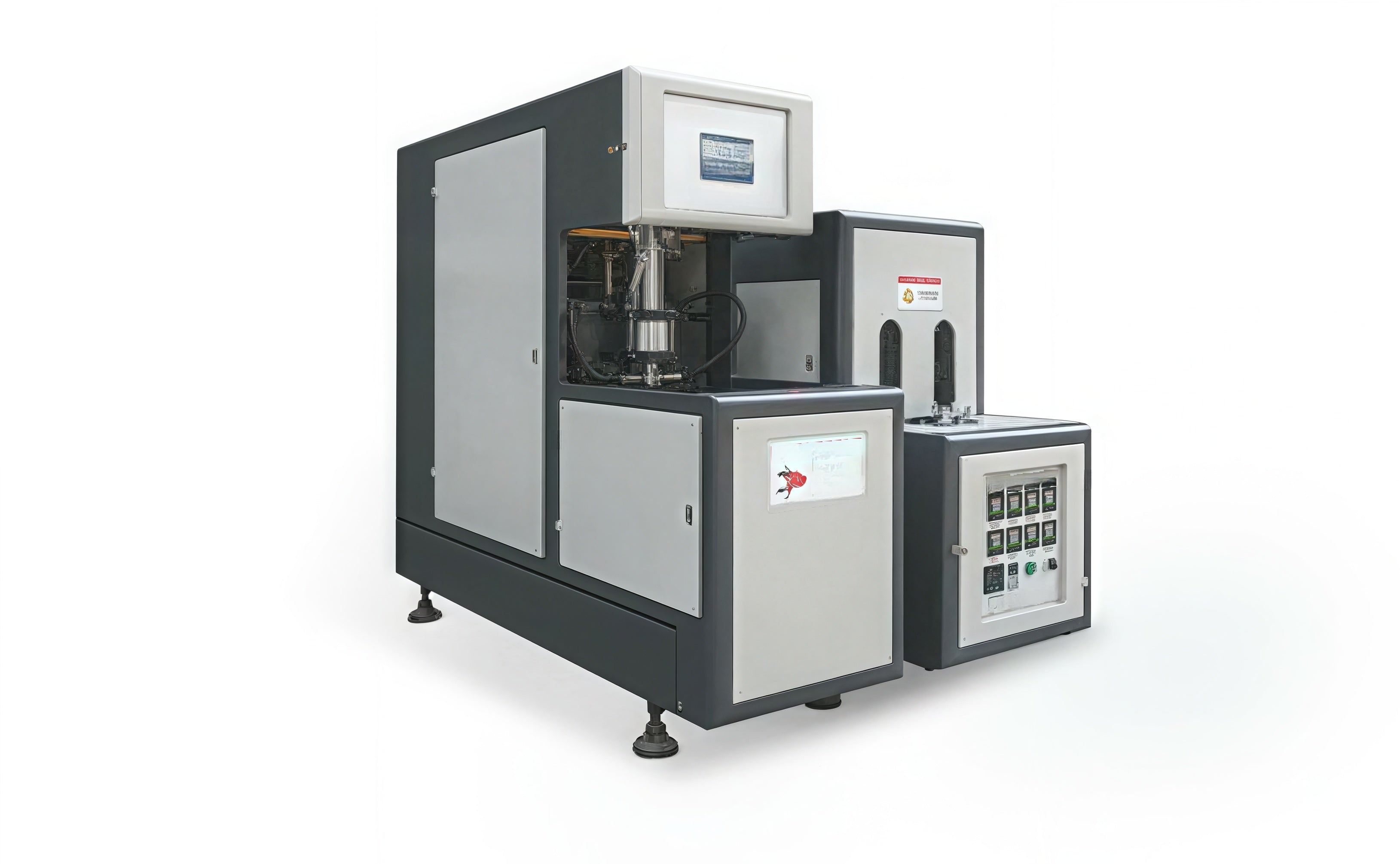
A typical semi-automatic PET blow molding machine consists of two primary subsystems: the preform heating oven and the blowing unit-1-.
Infrared Preform Oven: The oven is responsible for heating PET preforms to the optimal temperature required for subsequent stretching and blowing-1. It employs infrared heating elements that can be independently adjusted to achieve precise temperature control across different zones of the preform-1. The oven typically features a carousel or conveyor system that transports preforms through the heating chamber-24. During transit, preforms not only move along the conveyor path but also rotate around their own axes, ensuring uniform heat distribution-24. This rotation is critical because uneven heating can lead to defects such as bottle neck bending and wall thickness variations-21.
Blowing Unit: The blowing unit performs the core bottle-forming operations, including preform sealing, stretching, high-pressure blowing, exhaust, and mold control-1. It consists of a mold clamping mechanism, stretch rod assembly, high-pressure and low-pressure air systems, and a PLC-based control system-1. Advanced machines incorporate patented blow air heating systems and pre-blow functions to enhance bottle quality and eliminate whitening effects-1.
Auxiliary Systems: High-pressure air compressors (typically 25–35 bar) generate the pressure required to shape the plastic against the mold cavity, while low-pressure air compressors supply compressed air for preliminary inflation and auxiliary operations-1-.
2.2 Operational Sequence
The operational sequence of a semi-automatic PET blow molding machine follows a defined workflow-24:
-
Preform Loading: The operator manually places PET preforms onto the conveyor pins or holders in the infrared oven-24.
-
Preform Heating: Preforms travel through the oven, where infrared radiation raises the material temperature to the optimal softening point. The neck region is typically maintained at a lower temperature to preserve thread integrity, while the body is heated to the blowing temperature-14.
-
Preform Transfer: After exiting the oven, the heated preform is manually transferred by the operator to the blow mold cavity-24.
-
Mold Closing: The mold closes around the preform, and the neck is sealed-24.
-
Stretching and Blowing: A stretch rod extends axially to elongate the preform, followed by low-pressure pre-blowing and high-pressure blowing (25–35 bar) to force the material against the mold walls-24-.
-
Cooling: The formed bottle is cooled within the mold to set its shape-24.
-
Ejection: The mold opens, and the operator removes the finished bottle-24.
This cycle is then repeated for the next bottle. Production rates for semi-automatic machines typically range from 800 to 1,200 bottles per hour, depending on cavity count and operator proficiency-27-2.
3. The Two-Stage Stretch Blow Molding Process
3.1 Process Fundamentals
Semi-automatic PET blow molding machines operate on the two-stage (reheat) stretch blow molding principle-. In the first stage, PET preforms are produced via injection molding and subsequently cooled and stored. In the second stage, these preforms are reheated and blown into final bottles-2.
The blow molding process itself employs biaxial orientation—the PET polymer chains are stretched in both the axial and circumferential directions-. This biaxial stretching induces molecular orientation and strain hardening, which significantly enhances the mechanical properties of the finished bottle, including tensile strength, impact resistance, and barrier properties-.
3.2 Heating Principles
Preform heating is arguably the most critical operation in the two-stage process. The goal is to heat the preform body to a temperature above the glass transition temperature (Tg ≈ 76°C) while keeping the neck region below Tg to maintain dimensional stability-.
Infrared heating is the preferred method due to its efficiency and controllability. Modern machines employ zoned heating with multiple infrared lamps that can be independently adjusted based on preform geometry and bottle design-. Advanced control systems use feedback from temperature sensors to maintain precise temperature profiles-24.
Proper heating results in a transparent preform; if turbidity persists after heating, it indicates the onset of crystallization due to overheating-24. The crystallization line—the boundary between amorphous and crystallized polymer—must be carefully controlled, as crystallization prevents proper blowing and leads to defects-24.
4. Critical Process Parameters
The quality of bottles produced on semi-automatic machines is highly dependent on the proper setting and control of several key process parameters.
4.1 Preform Temperature
Preform temperature is the most influential parameter affecting bottle quality. Experimental studies have demonstrated that temperature variations significantly impact wall thickness uniformity, dimensional stability, and defect occurrence-20.
A study conducted at Malang State University investigated the effects of preform temperature on bottle quality using 12.5 g PET preforms and a 330 mL two-cavity mold-20. The results showed that a preform temperature of 80°C produced bottles with uniform wall thickness, flat bases, and minimal defects, while a lower temperature of 70°C resulted in high viscosity, leading to deformation and wrinkles-20. The optimal temperature combination achieved dimensional shrinkage below 1%-20.
For neck heating, temperature uniformity is critical. Temperature differences across the neck region should not exceed 3°C to prevent neck bending defects-21.
4.2 Blow Timing Parameters
Blow delay time and low-blow duration are critical timing parameters that affect bottle formation-. The experimental study mentioned above tested blow delay times ranging from 0.30 to 0.50 seconds and low-blow durations from 0.20 to 0.50 seconds-20. The optimal combination was found to be a preform temperature of 80°C combined with a low-blow duration of 0.50 seconds-20.
For addressing specific defects such as bottle neck bending, manufacturers recommend extending delayed blowing time to 0.8–1.2 seconds and reducing blowing pressure fluctuation to within ±0.05 MPa-21.
4.3 Blowing Pressure
Blowing pressure is a critical parameter that must be matched to bottle size, preform weight, and desired wall thickness. Typical high-pressure blowing ranges from 25 to 35 bar (2.5–3.5 MPa)-14-. The pre-blow pressure typically ranges from 5 to 10 bar, while the final blow pressure reaches 20–40 bar-.
For larger bottles, higher pressures may be required, with some sources recommending blow pressures between 20 and 40 bar depending on bottle volume-. Proper pressure control is essential for complete mold filling and consistent wall thickness.
4.4 Clamping and Mold Parameters
Mold clamping pressure and mold gap are important mechanical parameters. Recommended clamping pressure is 8–10 MPa, with a mold gap of ≤0.5 mm-21. Proper venting is also essential; manufacturers recommend at least three vent holes on each side of the mold-21.
5. Quality Control and Defect Mitigation
5.1 Common Defects
Semi-automatic PET blow molding operations are susceptible to several quality defects-20:
-
Wrinkles: Caused by insufficient heating or improper stretching
-
Collapses: Resulting from inadequate blowing pressure or premature cooling
-
Wall irregularities: Arising from uneven temperature distribution
-
Neck bending: Caused by uneven heating or improper stretch rod alignment-21
-
Incomplete bottom forming: Often due to improper pre-blowing control-
-
Whitening: Caused by crystallization from overheating-1
5.2 Defect Mitigation Strategies
Neck Bending: Solutions include optimizing heating settings to ensure uniform temperature distribution, adjusting stretch rod alignment, reducing stretch ratio, and extending delayed blowing time-21.
Incomplete Bottom Formation: Recommendations include verifying high-pressure gas supply (above 28 bar), adjusting pre-blowing and high-pressure blowing control elements, and optimizing temperature settings-.
General Quality Improvement: The pre-blow function is crucial for achieving high-quality bottles. Proper pre-blowing ensures that the preform is evenly pre-inflated before final high-pressure blowing, reducing the risk of wall thickness variations and eliminating whitening effects-1.
5.3 Quality Inspection
Quality assessment typically involves thickness measurements at multiple points, dimensional verification, and visual inspection for defects-20. For mass production, statistical process control methods are often employed to monitor key quality indicators and detect process drift.
6. Semi-Automatic vs. Fully Automatic Machines
6.1 Operational Comparison
The fundamental distinction between semi-automatic and fully automatic machines lies in the degree of human intervention-. In semi-automatic operation, the operator manually places preforms in the oven, transfers heated preforms to the mold, and removes finished bottles-14. In fully automatic systems, these operations are performed by automated conveyors and robotic transfer arms, requiring minimal human intervention-27.
6.2 Production Capacity
Production capacity differs substantially between the two categories. Semi-automatic machines typically produce 800–1,200 bottles per hour-27-2, with some advanced models reaching 2,800 BPH for 500 ml bottles-. Fully automatic machines can achieve significantly higher outputs, with high-speed systems reaching 10,000–30,000 BPH and advanced rotary machines exceeding 60,000 BPH-30.
6.3 Cost Considerations
Semi-automatic machines offer substantially lower initial investment costs--14. For startups and small-to-medium enterprises with limited budgets, this lower entry cost is a significant advantage-. Additionally, semi-automatic machines typically have lower energy consumption compared to fully automatic systems-.
However, the trade-off is higher labor costs per unit of output. Semi-automatic machines require more workers per unit of output, while automatic lines are designed to reduce operator dependence-.
6.4 Flexibility
Semi-automatic machines offer superior flexibility for small-batch, multi-variety production-. Mold changes can be performed quickly, accommodating different bottle sizes and shapes-. This makes semi-automatic machines particularly suitable for applications requiring frequent product changeovers, such as contract manufacturing or product development-14.
6.5 Application Suitability
Semi-automatic machines are ideally suited for-:
-
Startup operations and small-scale companies
-
Small-batch, multi-variety production
-
Special bottle shapes (e.g., irregular shapes, small-capacity bottles)
-
Applications with limited production requirements
-
Operations where capital investment is constrained
Fully automatic machines are better suited for-:
-
Large-scale, high-volume production
-
Operations requiring minimal labor input
-
Integrated production lines with filling and packaging
7. Market Trends and Economic Analysis
7.1 Global Market Overview
The global market for semi-automatic PET blow molding machines demonstrates steady growth. In 2024, the global market was valued at approximately US389millionandisprojectedtoreachUS 509 million by 2031, representing a compound annual growth rate (CAGR) of 3.9%-. Global production reached 29,621 units in 2024, with an average selling price of US$ 10,820 per unit-14.
7.2 Regional Dynamics
The Asia-Pacific region, particularly China, represents a significant and rapidly growing market-14. China's semi-automatic PET blow molding machine market is expected to grow at a CAGR of 3.9% from 2026 to 2032-. This growth is driven by the expanding food and beverage industry, increasing demand for packaged goods, and the proliferation of small-to-medium manufacturing enterprises-.
7.3 Key Manufacturers
Major players in the semi-automatic PET blow molding machine market include Tetra Laval, Krones AG, KHS GmbH, SIPA, and Nissei-14. These companies compete across various product segments, with differentiation based on cavity count, production capacity, energy efficiency, and control system sophistication-.
8. Future Perspectives
8.1 Technological Advancements
Several technological trends are shaping the future of semi-automatic PET blow molding machines:
Improved Heating Systems: Advanced infrared heating with zoned control and real-time temperature feedback is becoming standard-. Future developments may include more sophisticated temperature profiling based on preform geometry and material properties.
Enhanced Control Systems: PLC-based control systems with touchscreen interfaces and remote monitoring capabilities are increasingly common--. Integration with Industry 4.0 concepts, including predictive maintenance and real-time quality monitoring, represents the next frontier-.
Energy Efficiency: Ongoing efforts to reduce energy consumption through optimized heating element design and improved insulation are expected to continue-.
8.2 Sustainability Considerations
The growing emphasis on sustainability in packaging is driving several developments. PET's recyclability makes it an attractive material choice, and the blow molding industry is increasingly focused on using recycled PET (rPET)-20. However, rPET presents processing challenges due to variations in material properties, requiring more sophisticated process control—an area where advances in semi-automatic machine controls can contribute.
8.3 Market Outlook
The semi-automatic segment is expected to maintain its relevance despite the growth of fully automatic systems. The continued proliferation of small-to-medium enterprises, particularly in developing economies, along with the demand for flexible production capabilities, will sustain demand for semi-automatic machines-. The projected CAGR of 3.2–3.9% indicates stable, if modest, growth-14-.
9. Conclusion
Semi-automatic PET stretch blow molding machines represent a mature yet evolving technology that occupies an important niche in the plastic packaging industry. Operating on the two-stage reheat stretch blow molding principle, these machines offer a practical balance between manual operation and full automation, making them particularly suitable for small-to-medium enterprises, startup operations, and applications requiring high flexibility in bottle design and batch size.
The key to successful operation lies in the precise control of critical process parameters, particularly preform temperature, blow timing, and blowing pressure. Experimental studies have demonstrated that optimized parameter combinations—such as 80°C preform temperature combined with appropriate blow timing—can produce bottles with uniform wall thickness, flat bases, and minimal defects. Common quality defects can be effectively mitigated through systematic parameter optimization and proper machine maintenance.
While fully automatic machines offer higher production rates and lower labor requirements, semi-automatic machines retain significant advantages in terms of lower capital investment, operational simplicity, and production flexibility. With the global market projected to reach US$ 509 million by 2031, the semi-automatic segment demonstrates continued relevance and growth potential.
Future developments in heating technology, control systems, and energy efficiency will further enhance the capabilities of semi-automatic machines. As sustainability concerns drive increased use of recycled PET, the ability to maintain product quality with variable material properties will become increasingly important—an area where the flexibility and operator involvement inherent in semi-automatic operation may prove advantageous.
-
Đăng trong
Blow molding machine