Advances in PET Blow Molding Machines: Technology, Applications, and Sustainable Innovation Abstract
1. Introduction
Since its commercial adoption in the 1970s for carbonated soft drinks, PET blow molding has revolutionized liquid packaging due to its clarity, strength-to-weight ratio, gas barrier properties, and full recyclability [4][5]. Today, PET containers dominate markets ranging from 500 mL water bottles to 8 L edible oil jugs, with annual global production surpassing 1 trillion units [4].
The primary method for producing these containers is two-stage (or “reheat”) stretch blow molding, which separates preform injection molding from final bottle blowing—a configuration that enables high-speed, high-quality output with minimal material waste [5][8]. Recent advancements in automation, materials science, and environmental regulation have propelled PET blow molding machines into a new era of smart, green manufacturing.
2. Process Fundamentals: Two-Stage Stretch Blow Molding
The two-stage process involves:
- Preform Manufacturing: Injection-molded PET preforms (test-tube-shaped) are produced with precise neck finishes and wall distribution.
- Reheating: Preforms are heated uniformly (except the crystallized neck) using infrared lamps to ~100–120°C—above glass transition but below melting point [5].
- Stretching & Blowing: A mechanical rod performs axial stretching while high-pressure air (25–40 bar) radially expands the preform inside a cooled mold [1].
- Cooling & Ejection: The bottle solidifies within seconds and is automatically removed.
This biaxial orientation enhances mechanical strength, barrier performance, and optical clarity—critical for carbonated beverages and edible oils [1][5].
3. Machine Types and Architectures
3.1 Linear Servo-Electric Machines
Models like the SJ-CP6 (Ouge Machinery) feature:
- Full electric servo drives for parison transfer, stretching, and mold opening,
- Compact footprint with 6–8 cavity output,
- Energy savings via reduced hydraulic loss and precise motion control [8].
Ideal for SMEs, these machines support rapid changeovers between narrow-neck (water) and wide-mouth (cosmetic) bottles.
3.2 Rotary High-Speed Systems
Krones’ Contiform BigBottle exemplifies industrial-scale performance:
- 10–14 blow stations,
- Output up to 16,800 bottles/hour (for 2–8 L containers),
- Integrated modules: Contifeed preform feeding, PET-View quality inspection, Air Wizard Triple for 30% compressed air savings [3].
Over 80% of Contiform machines are delivered as Bloc combinations—integrated with fillers and labelers for end-to-end line efficiency [3].
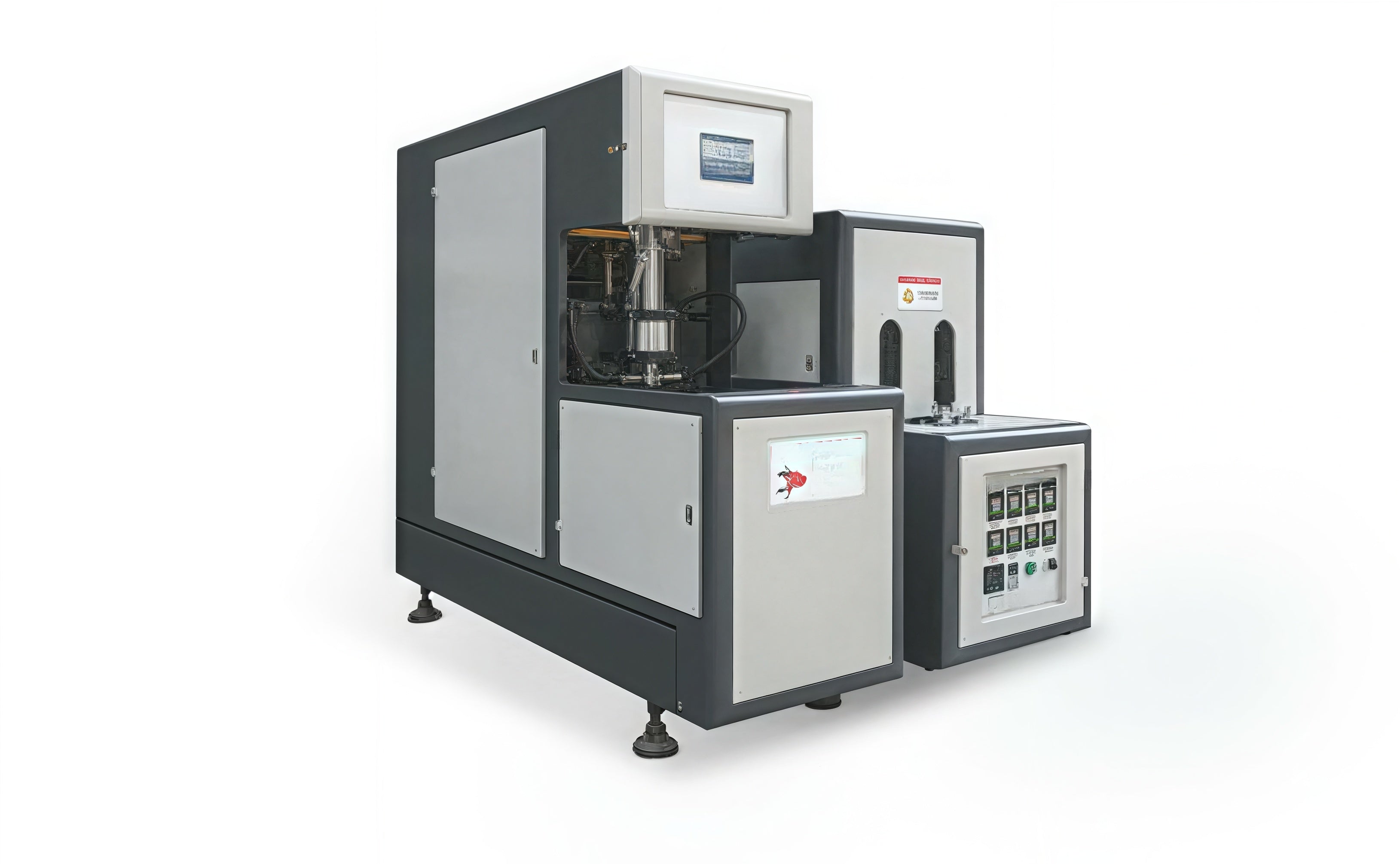
3.3 Semi-Automatic and Entry-Level Units
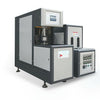
Chinese manufacturers like Ruiying Machinery offer cost-effective 1-cavity machines (e.g., D01-200/1) with:
- Manual or hand-fed preform loading,
- PLC control (Panasonic, Omron components),
- Capacity up to 6 L at ~600 bph [2][7].
These cater to regional beverage and agrochemical producers in Southeast Asia and Africa.
4. Key Technological Innovations
| Innovation | Impact |
|---|---|
| AI Process Control (e.g., Contiloop AI) | Automatically adjusts heating and blowing parameters based on real-time feedback, reducing scrap by 15–20% [3]. |
| Multi-Cavity Molds (1–8 cavities) | Boosts throughput without increasing floor space; common in 500 mL–2 L segments [10]. |
| Infrared Heating Optimization | Shorter heating zones, better temperature uniformity, and 10–15% lower energy use [3][8]. |
| Compressed Air Recovery | Recycles exhaust air for pre-blow stages, cutting total air consumption by up to 30% [3]. |
| Lightweighting Support | Machines now handle ultra-thin preforms (<10 g for 500 mL), reducing material use by 25% since 2010 [13]. |
5. Applications Across Industries
- Beverages: Carbonated drinks, water, juice, functional beverages (dominant segment, >60% of market) [4].
- Food: Edible oils, vinegar, sauces (requires oxygen barrier layers).
- Pharmaceuticals: Syrup bottles, IV solution containers (demanding strict hygiene and dimensional accuracy) [5].
- Personal Care: Shampoo, lotion, cosmetic jars (often wide-mouth, requiring specialized molds) [10].
Emerging uses include battery casings for EVs and medical diagnostic kits, expanding beyond traditional packaging [4].
6. Sustainability and Policy Drivers
Global regulations—such as China’s Plastic Pollution Governance Action Plan mandating 30% recycled content by 2025—are accelerating adoption of:
- PCR-compatible machines: Designed to handle post-consumer recycled (PCR) PET without degradation [4].
- Energy-efficient designs: Over 68% of new machines now meet Tier-1 energy standards [4].
- Closed-loop water and air systems: Minimize resource waste [3].
Moreover, PET’s infinite recyclability aligns with EU and ASEAN circular economy roadmaps, reinforcing long-term demand for blow molding equipment.
7. Market Trends and Future Outlook
According to QYResearch (2025), the global automatic PET blow molding machine market will exceed $XX billion by 2031, with:
- China accounting for over 50% of mid-tier machine production,
- SME-targeted models growing fastest in RCEP countries (+37% YoY exports) [4],
- Digital twins and IoT integration expected in 60% of new machines by 2030 [4].
Challenges remain—particularly dependence on imported servo motors and optical-grade PET resin—but domestic innovation in control systems and mold design is narrowing the gap with European leaders like Sidel and Krones [4][9].
8. Conclusion
PET blow molding machines stand at the intersection of precision engineering, digital intelligence, and environmental responsibility. From compact servo-electric units serving local markets to AI-optimized rotary lines producing thousands of bottles per hour, the technology continues to evolve in response to consumer demand, regulatory pressure, and sustainability imperatives. As lightweighting, recyclate integration, and smart manufacturing converge, PET blow molding will remain indispensable to the future of responsible packaging.
-
Đăng trong
extrusion blow molding machine