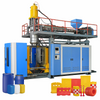

Extrusion Blow Molding Machines: Principles, Technologies, and Industrial Applications Abstract
1. Introduction Extrusion blow molding (EBM) emerged during World War II for producing low-density polyethylene (LDPE) bottles and rapidly evolved with the advent of high-density polyethylene (HDPE) in the 1950s [1][3]. Today, it remains the dominant process for fabricating hollow plastic parts due to its simplicity, cost-effectiveness, and adaptability across industries—from daily chemical packaging to automotive fuel tanks and industrial IBC totes [1][2]. The fundamental principle involves extruding a molten...

Design and Application of 1L Extrusion Blow Molding Machines in Daily Chemical Packaging Production Abstract
1. Introduction The global demand for 1-liter plastic containers—particularly in the home care and personal hygiene sectors—has surged due to urbanization, e-commerce logistics, and consumer preference for standardized, easy-to-handle volumes [3][4]. In response, the 1L extrusion blow molding machine has evolved from a basic semi-automatic unit into a digitally controlled, energy-conscious production system tailored for high-mix, low-to-medium volume manufacturing. Unlike large-scale accumulator-head machines used for IBC tanks or automotive fuel...

Design, Optimization, and Industrial Application of Semi-Automatic PET Blow Molding Machines
1. Introduction Plastic pollution is one of the most pressing environmental challenges of the 21st century. Globally, over 400 million tons of plastic are produced annually, yet less than 9% is recycled [5]. In China, annual plastic waste exceeds 60 million tons, with packaging and bottles accounting for more than 35% [8][10]. To close this loop, mechanical recycling remains the most scalable solution—and at its core lies the plastic shredder....

Design and Industrial Application of 5L Extrusion Blow Molding Machines for High-Volume Hollow Container Manufacturing
Design and Industrial Application of 5L Extrusion Blow Molding Machines for High-Volume Hollow Container Manufacturing
Abstract
The 5-liter (5L) extrusion blow molding (EBM) machine represents a critical segment in the production of mid-to-large capacity hollow plastic containers, widely used for industrial chemical drums, automotive fluid reservoirs, household cleaning product packaging, and agricultural reagent bottles. This paper presents a comprehensive technical analysis of modern 5L EBM systems, focusing on their dual-station architecture, precision wall thickness control, energy-efficient drive systems, and compatibility with recycled materials. A typical 5L machine features an 85–90 mm screw extruder (L/D = 24–25), continuous central-feed die head, servo-hydraulic clamping unit with up to 196 kN force, and PLC-based intelligent control. Advanced parison control—enabled by 20–32 programmable mandrel zones and infrared positioning (±0.5 mm accuracy)—ensures wall thickness tolerance within ±0.15 mm. Energy consumption is reduced by 25–65% through variable frequency drives (VFDs) and electromagnetic barrel heating. With China’s blow molding equipment market projected to reach RMB 12.27 billion by 2030 and global demand for sustainable, lightweight packaging rising, the 5L EBM machine exemplifies the convergence of automation, material efficiency, and eco-conscious design in modern plastics manufacturing.
Keywords: 5L extrusion blow molding; hollow container; wall thickness control; VFD energy saving; dual-station design; HDPE; electromagnetic heating; recycled plastic
1. Introduction
Extrusion blow molding (EBM) is the dominant method for producing seamless, cost-effective hollow thermoplastic containers in the 2–10L range. Among these, the 5-liter (5L) EBM machine occupies a strategic position—large enough for industrial applications yet compact enough for high-speed, automated production lines [4][7]. Typical end products include engine oil containers, pesticide drums, detergent jugs, and food-grade edible oil bottles.
In China—the world’s largest manufacturer of small-to-mid capacity blow molding equipment—companies such as Guangdong Lesun Intelligent Equipment and Dongguan Golden Sincerity Machinery offer standardized 5L platforms (e.g., SCJ-85-65-30U2×2.15F) capable of ≤28-second cycle times and output rates exceeding 1,000 pieces per hour in dual-station mode [4][9]. This paper examines the mechanical design, control logic, energy optimization, and sustainability features of contemporary 5L EBM machines.
2. Machine Configuration and Core Components
A representative 5L extrusion blow molding machine (based on the SCJ-85 series) includes the following specifications [4][9]:
| Component | Specification |
|---|---|
| Main Screw Diameter | 85 mm |
| L/D Ratio | 24:1 |
| Extruder Motor Power | 37 kW |
| Plasticizing Capacity | 130 kg/h (HDPE) |
| Die Head Type | Continuous central-feed |
| Die Head Heating Zones | 5 |
| Clamping Force | 196 kN |
| Mold Opening Stroke | Up to 750 mm |
| Template Size | 600 × 500 mm |
| Blow Pressure | 0.6–0.8 MPa |
| Cooling Water Flow | ~0.5 m³/min |
| Cycle Time | ≤28 s |
| Output (Dual-Station) | Up to 1,100–1,200 pcs/h |
The dual-station linear guide rail system ensures smooth mold carriage movement, reduces vibration, and enhances positioning repeatability—critical for consistent 5L bottle quality over long production runs [4][9].
3. Wall Thickness Control and Product Quality
Uniform wall distribution is essential for 5L containers to pass drop tests (e.g., ASTM D2911) and resist internal pressure from viscous or volatile contents. Modern 5L machines implement:
- Multi-point parison control: Up to 32 programmable zones adjust die gap during extrusion, compensating for sag and ensuring optimal material distribution [1].
- Infrared parison positioning: Aligns the hot parison with the mold cavity within ±0.5 mm, minimizing flash and reducing scrap rates to <0.5% [11].
- Pre-blow and sequential blowing: Prevents parison adhesion and ensures even expansion, especially in deep-draw geometries like narrow-neck chemical drums [1].
These technologies enable wall thickness variation of <±0.15 mm, allowing 8–12% material savings without compromising burst strength (>0.3 MPa)—a key requirement for industrial and automotive packaging [4][7].
4. Energy Efficiency and Sustainability
Energy consumption is a major operational cost in plastic processing. Two key innovations now standard in 5L EBM machines are:
4.1 Variable Frequency Drives (VFDs)
Traditional hydraulic systems run oil pumps at fixed speed (50 Hz), wasting energy via overflow valves. VFDs modulate motor speed based on real-time demand. According to pump affinity laws:
Reducing motor frequency from 50 Hz to 35 Hz cuts power consumption by ~65%. Field data show 25–65% energy savings after VFD integration [1][2].
4.2 Electromagnetic Heating
Replacing resistive heaters with induction coils offers:
- 30–70% higher thermal efficiency,
- 25% faster warm-up,
- Reduced ambient heat loss due to integrated insulation [1].
For a 5L machine operating 20 hours/day, annual energy savings reach 10,000–15,000 kWh, aligning with China’s “Dual Carbon” policy and ISO 50001 energy management standards [2][5].
5. Material Flexibility and Circular Economy Integration
Modern 5L EBM machines support a wide range of thermoplastics:
- HDPE (most common for chemical resistance),
- PP (for high-temperature applications),
- Recycled HDPE (rHDPE)—up to 100% in non-food applications [11].
Advanced co-extrusion systems (e.g., 4-layer: virgin/rHDPE/opaque/pigmented) allow manufacturers to use dark recycled cores while maintaining bright, clean exteriors—enabling circular economy compliance without sacrificing aesthetics [11].
6. Industrial Applications
The 5L format is ideal for:
- Automotive: Transmission fluid, coolant, and brake fluid reservoirs,
- Agriculture: Herbicide and pesticide containers,
- Household: Bulk laundry detergent and floor cleaner bottles,
- Industrial: Solvent drums, lubricant carriers, and reagent vessels.
Its balance of capacity, stackability, and drop resistance makes it a logistics favorite across global supply chains [7].
7. Future Trends
The next generation of 5L EBM machines will likely feature:
- Full-electric servo clamping (eliminating hydraulic oil and noise),
- IoT-enabled remote monitoring with predictive maintenance,
- AI-driven process optimization using digital twins,
- Integration with robotic palletizing for lights-out manufacturing [5][10].
Moreover, modular design and quick-change tooling will shorten setup times—critical for FMCG brands managing hundreds of SKUs.
8. Conclusion
The 5-liter extrusion blow molding machine stands at the intersection of industrial robustness and high-efficiency automation. Through dual-station architecture, intelligent parison control, and advanced energy-saving systems, it delivers reliable, low-waste production of essential containers across automotive, chemical, and consumer sectors. As global regulations tighten on plastic waste and carbon emissions, the 5L EBM machine—especially when paired with recycled feedstock and smart controls—will remain a cornerstone of sustainable, scalable packaging manufacturing. In China and beyond, its evolution reflects the broader shift toward green, intelligent, and human-centered industrial machinery.
References
[1] Baidu Baike. Extrusion Blow Molding Machine. December 23, 2024.
[2] Baidu Baike. Energy Efficiency in Plastic Machinery. 2024.
[3] TaoDou Network. Research Progress on Hollow Blow Molding Technology. March 11, 2025.
[4] Guangdong Lesun Intelligent Equipment. SCJ-85-65-30U2×2.15F Technical Specifications. 2025.
[5] Zhongkai Strategy Consulting. Market Analysis of Blow Molding Machines in China. October 10, 2025.
[6] Renrenwenku. Global and Chinese EBM Machine Market Report. April 24, 2025.
[7] Sohu Finance. China Blow Molding Industry Outlook 2023–2030. March 14, 2025.
[8] Dongguan Golden Sincerity Machinery. XL Series Blow Molding Platform Brochure. 2025.
[9] Plastic Machinery Supply Network. 5L Dual-Head Blow Molding Machine Parameters. October 21, 2025.
[10] China Cone Twin-Screw Extruder Industry Report. 2025–2030 Development Outlook. June 7, 2025.
[11] US Patent US20220266451A1. Coextruded Multilayer Plastic Blow Molded Container. August 22, 2022.

2.5L Hollow extrusion blow molding machine
1. Introduction Extrusion blow molding (EBM) remains the dominant method for producing seamless, cost-effective hollow thermoplastic containers in the 1–5L range. The 2.5-liter (2.5L) EBM machine occupies a strategic niche between small-volume (1L) and large-volume (>5L) systems, offering optimal balance for applications requiring robust structural integrity without excessive material use—such as engine oil bottles, detergent jugs, and chemical storage vessels [4][8]. In China—the world’s largest producer of small-to-mid capacity blow...

Design and Application of 1.8L Extrusion Blow Molding Machines for High-Performance Hollow Container Production
Design and Application of 1.8L Extrusion Blow Molding Machines for High-Performance Hollow Container Production
Abstract
The 1.8-liter (1.8L) extrusion blow molding (EBM) machine occupies a strategic niche in the production of mid-volume hollow plastic containers, widely used for automotive lubricant bottles, household chemical packaging, and industrial reagent vessels. This paper presents a detailed technical analysis of modern 1.8L EBM systems, emphasizing their dual-station architecture, precision wall thickness control, and integration of energy-efficient technologies. Key components—including a 90 mm screw extruder (L/D = 25), continuous central-feed die head, servo-hydraulic clamping unit, and PLC-based intelligent control—are examined with reference to industry-standard models such as the HTⅡ-18L and YJH90-12LⅡ series (capable of 1–12L output). The implementation of variable frequency drives (VFDs) and electromagnetic barrel heating reduces energy consumption by 25–65%, aligning with China’s national “Dual Carbon” policy. Advanced features such as dual linear rail mold locking, infrared positioning (±0.5 mm accuracy), and multi-point mandrel control enable wall thickness tolerances within ±0.15 mm and product yields exceeding 99.5%. With China’s mid-capacity blow molding equipment market projected to grow at 6–7% CAGR through 2030, this study highlights the 1.8L EBM machine as a benchmark for efficiency, reliability, and automation in sustainable packaging manufacturing.
Keywords: 1.8L extrusion blow molding; hollow container; wall thickness control; VFD energy saving; dual-station design; HDPE; PLC automation; electromagnetic heating
1. Introduction
Extrusion blow molding (EBM) remains the dominant method for manufacturing seamless, cost-effective hollow thermoplastic containers in the 1–5L range. Among these, the 1.8-liter (1.8L) EBM machine has emerged as a preferred solution for applications requiring slightly larger capacity than standard 1L bottles—such as engine oil containers, premium detergent packaging, and industrial chemical drums—without the complexity and cost of large-volume (>10L) systems [4][8].
In China, where over 96,000 EBM machines were produced in 2025 alone [8], manufacturers like Tongda Mechanical and Yijiu Machinery offer modular platforms (e.g., HTⅡ-18L, YJH90-12LⅡ) capable of producing 1.8L containers with cycle times under 25 seconds and output rates exceeding 1,200 pieces per hour in dual-station mode [4][6]. This paper examines the design, control logic, and performance optimization of contemporary 1.8L EBM machines, with emphasis on precision, energy efficiency, and adaptability to recycled HDPE feedstock.
2. Machine Configuration and Core Components
A typical 1.8L extrusion blow molding machine (e.g., HTⅡ-18L) features the following specifications [4][6][11]:
| Component | Specification |
|---|---|
| Screw Diameter | 90 mm |
| L/D Ratio | 25:1 |
| Motor Power | 37 kW |
| Plasticizing Capacity | 140 kg/h (HDPE) |
| Die Head Type | Continuous central-feed |
| Heating Zones | 4 (barrel) + 4 (die head) |
| Clamping Force | 120 kN |
| Mold Opening Stroke | 280–750 mm |
| Blow Pressure | 0.6 MPa |
| Cooling Water Flow | 60 L/min |
| Cycle Time | ≤25 s |
| Output (Dual-Station) | Up to 1,200 pcs/h |
The dual-station design enables continuous production: while one mold cools the 1.8L bottle, the second performs extrusion, clamping, blowing, and ejection—effectively eliminating idle time and doubling throughput compared to single-station units [5][11].
3. Wall Thickness Control and Product Quality
Uniform wall distribution is critical for 1.8L containers to meet drop-test standards (e.g., ASTM D2911) and chemical resistance requirements. Modern machines employ:
- Servo-controlled mandrel positioning: Adjusts die gap in real time during parison extrusion, supporting up to 32 programmable control points along the parison length [4].
- Pre-blow function: A low-pressure air pulse prevents parison wall adhesion before main inflation [5].
- Infrared positioning system: Aligns the parison with the mold cavity within ±0.5 mm, minimizing flash and material waste [4].
These technologies enable wall thickness variation of <±0.15 mm, reducing raw material usage by 8–12% while maintaining structural integrity—particularly vital for automotive and chemical packaging [4][8].
4. Energy Efficiency and Sustainability
Plastic processing accounts for a significant share of industrial electricity use in China. Two key energy-saving technologies are now standard in 1.8L EBM machines:
4.1 Variable Frequency Drives (VFDs)
Traditional hydraulic systems run oil pumps at fixed speed (50 Hz), wasting energy via overflow valves. VFDs modulate motor speed based on real-time demand. According to pump affinity laws:
Reducing motor frequency from 50 Hz to 35 Hz cuts power consumption by ~65%. Field data show 25–65% energy savings after VFD retrofitting [2][5].
4.2 Electromagnetic Heating
Replacing resistive heaters with induction coils offers:
- 30–70% higher thermal efficiency,
- 25% faster warm-up,
- Reduced ambient heat loss due to integrated insulation [2].
For a 1.8L machine operating 20 hours/day, annual energy savings reach 8,000–12,000 kWh, supporting China’s carbon peaking goals [2][8].
5. Industrial Applications
The 1.8L EBM machine is ideal for:
- Automotive: Engine oil, transmission fluid, and coolant bottles,
- Household: Premium detergent, fabric softener, and bleach containers,
- Industrial: Reagent drums, pesticide bottles, and solvent carriers.
Its capacity balances material economy and handling convenience, making it a staple in logistics and retail packaging. Leading Chinese manufacturers now offer compatibility with post-consumer recycled HDPE (rHDPE), enabling circular economy integration [8][12].
6. Future Trends
The next generation of 1.8L EBM machines will likely feature:
- Full-electric servo clamping (replacing hydraulics for quieter, cleaner operation),
- IoT-enabled remote monitoring with cloud-based diagnostics,
- AI-driven process optimization using digital twins,
- Multi-layer co-extrusion (e.g., HDPE/EVOH/HDPE) for barrier packaging in food and fuel applications [3][10].
Moreover, modular design and standardized components will shorten delivery cycles and reduce maintenance costs—key priorities for global OEMs [10].
7. Conclusion
The 1.8-liter extrusion blow molding machine represents a mature yet continuously evolving platform that bridges the gap between small-bottle efficiency and mid-volume functionality. Through dual-station architecture, intelligent wall thickness control, and advanced energy-saving systems, it delivers high-speed, low-waste production of essential industrial and consumer containers. As sustainability and automation reshape global manufacturing, the 1.8L EBM machine will remain a cornerstone of efficient, scalable, and eco-conscious plastic packaging production—particularly in China, where innovation and scale converge.
References
[1] Baidu Baike. “Extrusion Blow Molding Machine.” Updated December 23, 2024.
[2] “Energy Efficiency in Plastic Machinery.” Baidu Baike, 2024.
[3] TaoDou Network. “Research Progress on Hollow Blow Molding Technology.” March 11, 2025.
[4] Baidu Baike. “Hollow Blow Molding Equipment.” October 15, 2025.
[5] Guozhao Energy. “VFD Energy-Saving Application in Dual-Station Blow Molding Machines.” February 20, 2025.
[6] Marco Polo Network. “XL80-20L Blow Molding Machine Specifications.” April 27, 2025.
[7] Renrenwenku. “Market Share of Chinese Blow Molding Equipment Manufacturers.” April 24, 2025.
[8] Douding.com. “China Blow Molding Machine Industry Forecast 2025–2030.” January 4, 2025.
[9] QQ Reading. “Trends in Extrusion Blow Molding Technology.” February 26, 2020.
[10] QQ Reading. “Classification and Selection of Blow Molding Machines.” 2023.
[11] Practical Utility Patent CN220331944U. “High-Efficiency Automatic Blow Molding Machine.” January 29, 2024.
[12] Tongjia Machinery. “Custom Blow Molding Solutions for Industrial Packaging.” May 16, 2023.

Design and Optimization of 1L Extrusion Blow Molding Machines for High-Efficiency Hollow Plastic Container Production
Design and Optimization of 1L Extrusion Blow Molding Machines for High-Efficiency Hollow Plastic Container Production
Abstract
The 1-liter (1L) extrusion blow molding (EBM) machine is a cornerstone of modern small-volume hollow plastic container manufacturing, widely used for lubricant bottles, detergent containers, chemical reagent vessels, and automotive fluid reservoirs. This paper presents a comprehensive technical analysis of contemporary 1L EBM systems, emphasizing their dual-station architecture, precision wall thickness control, and integration of energy-efficient technologies. Key components—including a 90 mm screw extruder (L/D = 25), continuous die head, servo-hydraulic clamping unit, and PLC-based control system—are detailed with reference to industry-standard models such as the YJH90-12LⅡ. The implementation of variable frequency drives (VFDs) and electromagnetic barrel heating is shown to reduce energy consumption by 25–65%, aligning with China’s national “Dual Carbon” policy. Furthermore, innovations such as multi-point mandrel control and infrared mold alignment enable wall thickness tolerances within ±0.15 mm and product yields exceeding 99.5%. With China’s 1L blow molding equipment market projected to exceed RMB 5 billion by 2026, this study underscores the critical role of automation, material efficiency, and smart control in sustainable packaging production.
Keywords: 1L extrusion blow molding; hollow container; wall thickness control; VFD energy saving; dual-station design; HDPE; PLC automation
1. Introduction
Extrusion blow molding (EBM) is the most prevalent method for producing seamless, hollow thermoplastic containers in the 0.5–5L range. Among these, the 1-liter (1L) EBM machine has become a standard platform in packaging lines across automotive, household chemical, and pharmaceutical sectors due to its balance of speed, cost, and reliability [3][5][10].
Unlike injection blow molding—which offers higher dimensional accuracy but at greater tooling cost—EBM excels in low-to-mid volume production with minimal mold complexity and rapid changeover. In China, manufacturers such as Yijiu Machinery, LeShan Intelligent Equipment, and Tongda Mechanical have commercialized highly automated 1L machines capable of >1,200 pieces per hour with dual-station operation [3][12].
This paper examines the design, control logic, and performance optimization of modern 1L EBM machines, with emphasis on energy efficiency, product consistency, and adaptability to recycled HDPE feedstock.
2. Machine Configuration and Core Components
A typical 1L extrusion blow molding machine (e.g., YJH90-12LⅡ) features the following subsystems [3]:
| Component | Specification |
|---|---|
| Screw Diameter | 90 mm |
| L/D Ratio | 25 |
| Screw Motor Power | 37 kW |
| Extrusion Rate | 140 kg/h (HDPE) |
| Die Head Type | Continuous central-feed |
| Heating Zones | 4 (barrel) + 4 (die head) |
| Clamping Force | 120 kN |
| Mold Stroke | 280–750 mm |
| Blow Pressure | 0.6 MPa |
| Cooling Water Flow | 60 L/min |
| Cycle Time | ≤25 s |
| Output Capacity | 600 pcs/h per station × 2 = 1,200 pcs/h |
The machine operates on a dual-station principle: while one mold cools the part, the second performs extrusion, clamping, blowing, and ejection—effectively eliminating idle time and doubling throughput compared to single-station units [2][3].
3. Wall Thickness Control and Product Quality
Uniform wall distribution is critical for 1L containers to pass drop tests and meet regulatory standards (e.g., UN packaging for chemicals). Modern 1L machines employ:
- Servo-controlled mandrel positioning: Adjusts the die gap in real time during parison extrusion, enabling up to 32 control points along the parison length [5].
- Pre-blow function: A low-pressure air pulse prevents parison wall adhesion before main inflation [2].
- Infrared positioning system: Aligns the parison with the mold cavity within ±0.5 mm, minimizing flash and material waste [10].
These features allow wall thickness variation to be controlled within ±0.15 mm, reducing raw material usage by 8–12% without compromising structural integrity [5].
4. Energy Efficiency and Sustainability
Plastic processing accounts for ~5% of China’s industrial electricity consumption. To address this, 1L EBM machines now integrate two key energy-saving technologies:
4.1 Variable Frequency Drives (VFDs)
Traditional hydraulic systems run oil pumps at fixed speed (50 Hz), wasting energy via overflow valves. VFDs modulate motor speed based on real-time pressure demand. According to pump affinity laws:
A reduction from 50 Hz to 35 Hz cuts power consumption by ~65%. Field data from Shenzhen Guozhao Energy show 25–65% energy savings after VFD retrofitting [2].
4.2 Electromagnetic Heating
Replacing resistive heaters with induction coils directly heats the barrel, offering:
- 30–70% higher thermal efficiency,
- 25% faster warm-up,
- Reduced ambient heat loss due to integrated insulation [5].
For a 1L machine operating 20 hours/day, these measures save 8,000–12,000 kWh/year, supporting China’s carbon peaking goals [2][5].
5. Industrial Applications and Market Context
The 1L EBM machine dominates production of:
- Automotive: Engine oil bottles, brake fluid reservoirs,
- Household: Detergent, shampoo, and bleach containers,
- Agriculture: Pesticide and fertilizer bottles,
- Medical: Reagent and sample storage vials.
In China, over 48,000 EBM machines were produced in 2024, with small-capacity (<5L) units accounting for ~60% of total output [7]. Leading manufacturers like LeShan and Tongda offer modular 1L platforms compatible with recycled HDPE (rHDPE), enabling circular economy integration [10][12].
Recent patents (e.g., CN220331944U) highlight innovations such as rotary multi-mold heads, allowing rapid product changeover without manual die replacement—boosting flexibility for multi-SKU production lines [1].
6. Future Trends
The next generation of 1L EBM machines will likely feature:
- Full-electric servo clamping (replacing hydraulics for cleaner operation),
- IoT-enabled remote monitoring with cloud-based diagnostics,
- AI-driven process optimization using digital twins,
- Multi-layer co-extrusion for barrier packaging (e.g., EVOH/HDPE for fuel additives).
Moreover, compatibility with post-consumer recycled (PCR) resins will become standard, driven by EU and Chinese extended producer responsibility (EPR) regulations.
7. Conclusion
The 1-liter extrusion blow molding machine exemplifies the convergence of mechanical precision, intelligent control, and sustainable engineering. Through dual-station design, advanced wall thickness regulation, and energy-efficient technologies, it delivers high-speed, low-waste production of essential packaging components. As global demand for lightweight, recyclable containers grows, the 1L EBM platform will remain indispensable—particularly in China, where innovation and scale continue to drive the industry forward.

Hollow extrusion blow molding machine
1. Introduction The global demand for lightweight, durable, and cost-effective plastic containers has propelled extrusion blow molding (EBM) to the forefront of polymer processing technologies. Unlike injection or injection-stretch blow molding, EBM excels in producing large, seamless, and complex-shaped hollow parts—such as fuel tanks, chemical drums, toolboxes, and milk jugs—using materials like HDPE, PP, PVC, and PET [2][8][9]. An extrusion blow molding machine (also termed a hollow extrusion blow molding...