Advanced Design, Energy Efficiency, and Sustainable Deployment of Water-Cooled Screw Chillers in Modern Industrial and Commercial Applications Abstract
1. Introduction
As global energy consumption rises and climate regulations tighten, efficient and reliable cooling solutions are critical across sectors—from pharmaceutical manufacturing and data centers to commercial real estate and food processing. Among vapor-compression refrigeration technologies, the water-cooled screw chiller stands out for its robustness, scalability, and superior part-load performance.
Unlike air-cooled alternatives that reject heat directly to ambient air, water-cooled chillers use a closed-loop cooling tower system, enabling lower condensing temperatures (typically 30–35°C inlet) and thus higher thermodynamic efficiency—especially in hot and humid climates [5][7]. At the heart of these systems lies the twin-screw compressor, which offers smoother operation, fewer moving parts, and continuous capacity modulation from 10% to 100% via a sliding valve [2][4].
This paper presents a technical and economic analysis of contemporary water-cooled screw chillers, drawing on recent advancements driven by China’s “Dual Carbon” strategy (peak carbon by 2030, carbon neutrality by 2060) and international green building standards.
2. System Architecture and Thermodynamic Cycle
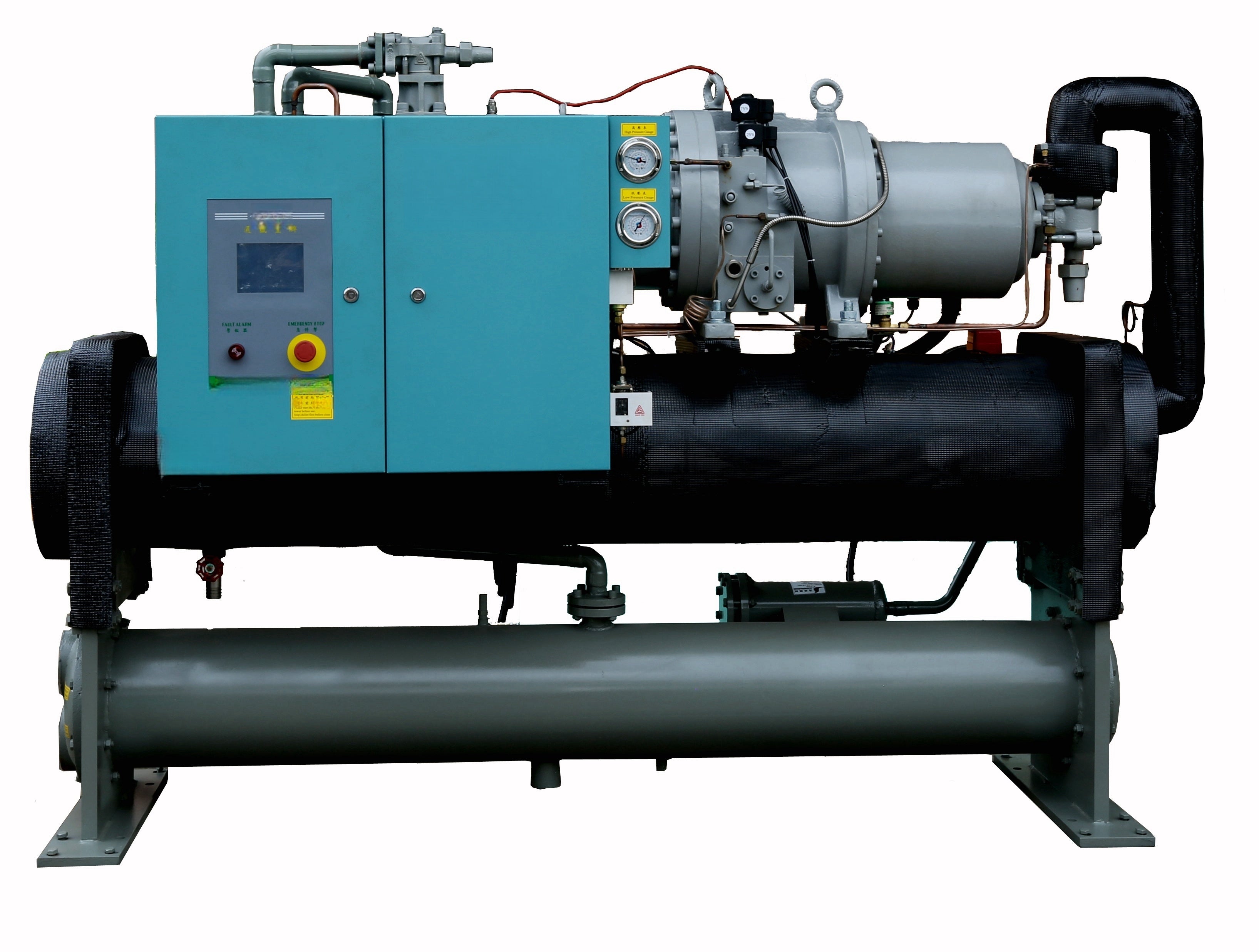
A standard water-cooled screw chiller operates on the reverse Carnot cycle, comprising four core components:
- Twin-screw compressor: Compresses low-pressure refrigerant vapor into high-pressure, high-temperature gas.
- Shell-and-tube condenser: Transfers heat from refrigerant to cooling water (typically 30–35°C inlet, 38–45°C outlet).
- Thermostatic expansion valve (TXV): Reduces pressure, causing refrigerant to flash into a liquid-vapor mixture.
- Flooded or dry evaporator: Absorbs heat from chilled water (typically 7°C outlet), completing the cycle.
The system circulates two independent water loops:
- Chilled water loop: Supplies cooling to end-use processes or air handling units.
- Cooling water loop: Rejects heat via an external cooling tower [5][7].
Modern units integrate microcomputer controllers that monitor:
- Evaporator/condenser pressures,
- Inlet/outlet water temperatures,
- Oil temperature and level,
- Motor current and vibration.
Safety features include high/low pressure cutouts, phase loss protection, and anti-freeze logic [5].
3. Core Technological Innovations
3.1 Twin-Screw Compressor with Asymmetric Rotors
Most units employ 5:6 asymmetric rotor profiles, achieving volumetric efficiency >95% and minimizing internal leakage [2][4]. The rotors are machined from high-strength alloy steel (e.g., 38CrMoAlA) and surface-nitrided to HV900 hardness for wear resistance [2].
Capacity is modulated via a sliding valve, enabling smooth, stepless adjustment from 10% to 100% load without cycling—a major advantage over fixed-speed reciprocating compressors [4].
3.2 Dual-Compressor (“Dual-Head”) Modular Design
Units with two independent screw compressors offer:
- Redundancy: One compressor can maintain ~70% cooling if the other fails,
- Load matching: Operate only one unit during low-demand periods, avoiding “big engine, small load” inefficiency,
- Extended lifespan: Alternating run hours balance mechanical wear [1][4].
According to industry data, dual-head systems achieve IPLV ≥ 6.0, representing 22% energy savings over single-compressor equivalents [1][4].
3.3 Variable Frequency Drives (VFDs) and Magnetic Bearings
VFDs adjust motor speed based on real-time cooling demand. In partial-load conditions (common in office buildings), VFD-equipped chillers achieve IPLV > 8.0, saving 25–35% energy vs. fixed-speed units [4].
Next-generation models use magnetic bearing compressors, eliminating mechanical friction. These achieve COP up to 7.4 and exhibit only 3% efficiency degradation over 5 years, compared to 18–22% for conventional oil-lubricated systems [4].
4. Energy Performance and Environmental Impact
Two metrics define chiller efficiency under GB 19577-2025 (China’s latest standard):
| Metric | Definition | 2025 Benchmark (Grade 1) |
|---|---|---|
| COP | Full-load cooling output / electrical input | ≥ 5.6 |
| IPLV | Weighted average COP at 100%, 75%, 50%, 25% loads | ≥ 6.0 |
Most modern units exceed these: typical COP = 5.8–6.3, IPLV = 6.5–8.5 [4][5].
On refrigerants, while R134a (GWP = 1,430) remains common, next-gen models adopt R513A (GWP = 573) or R1234ze (GWP < 1), reducing greenhouse impact by up to 78% [4]. A 1,000 RT chiller using R513A avoids ~2,800 tons of CO₂-equivalent emissions over 15 years [4].
5. Real-World Applications
5.1 Industrial Process Cooling
In a Jiangsu frozen food facility, a dual-head screw chiller maintains ±0.5°C precision for blast freezers, cutting annual electricity use by 870,000 kWh and reducing maintenance downtime by 60% [1][4].
5.2 Data Centers
AI-driven computing demands ultra-stable cooling. In Changsha, a cloud data center uses VFD screw chillers with free-cooling integration, achieving PUE < 1.3 and 40% higher IPLV than baseline systems [4].
5.3 Commercial HVAC
Large shopping malls in Guangzhou deploy modular chiller plants with BACnet-enabled group control, dynamically balancing loads across 4–6 units to optimize total system efficiency [1].
6. Maintenance and Reliability
Proper upkeep ensures long-term performance:
- Quarterly: Clean condenser tubes; target fouling resistance ≤ 0.0003 m²·K/W [4].
- Annually: Replace oil and filters; perform 240-hour continuous load test.
- Continuous monitoring: Vibration analysis shows that bearing clearance >0.15 mm reduces COP by 0.7, increasing annual consumption by 68,000 kWh [4].
Predictive maintenance using oil quality sensors and spectral vibration analysis can forecast 85% of failures 48+ hours in advance [4].
7. Future Trends
The next decade will see:
- Wider adoption of magnetic bearings for near-zero friction,
- AI-driven load forecasting to optimize chiller sequencing,
- Hybrid systems combining chillers with thermal storage or solar pre-cooling,
- Digital twins for real-time performance simulation and fault diagnosis.
With rising electricity costs and ESG reporting mandates, the water-cooled screw chiller is evolving from a utility device into an intelligent energy asset.
8. Conclusion
The water-cooled screw chiller remains indispensable in the quest for efficient, reliable, and sustainable thermal management. Through advances in compressor design, variable-speed control, and eco-friendly refrigerants, modern units deliver unmatched performance across diverse sectors. As global infrastructure decarbonizes, this mature yet continuously innovating technology will play a pivotal role in building a cooler—and greener—future.
-
Posted in
Industrial chiller