Design and Operational Analysis of a 2.5L Extrusion Blow Molding Machine for Plastic Bottle Production

1. Introduction
Extrusion blow molding is a dominant manufacturing method for producing hollow plastic containers. Among standard sizes, the 2.5-liter (approximately 85 oz) bottle has become increasingly popular in consumer markets for water, juice, cooking oil, and liquid cleaners. This paper examines a dedicated 2.5L EBM machine, analyzing its mechanical design, process control strategies, and performance metrics to support efficient and sustainable production.
2. Machine Configuration and Working Principle
The 2.5L EBM machine operates through five primary stages:
- Plasticizing: Resin pellets are melted in a single-screw extruder (L/D = 24:1).
- Parison Formation: Molten polymer exits through an annular die, forming a tubular parison.
- Mold Clamping: A two-part steel mold closes around the parison with a clamping force of ~180 tons.
- Inflation: Compressed air (30–45 psi) expands the parison to conform to the mold cavity.
- Cooling & Ejection: Internal air cooling and external water channels solidify the part before ejection.
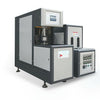
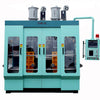
Critical components include an accumulator-head die for consistent parison delivery, a servo-hydraulic clamping system, and a PLC-based HMI for real-time parameter adjustment.
3. Key Design Considerations
Producing 2.5L bottles requires attention to:
- Wall Thickness Distribution: Thicker base and shoulder regions prevent deformation under load. Achieved via dynamic parison programming.
- Material Selection: HDPE offers excellent chemical resistance and impact strength; PP provides higher temperature tolerance.
- Cycle Time Reduction: Efficient cooling channels and fast mold opening mechanisms target cycles under 10 seconds.
4. Performance Evaluation
Trials using HDPE (MFI = 0.3 g/10 min) over 600 cycles yielded:
- Average cycle time: 8.7 s
- Bottle weight consistency: ±1.0%
- Minimum wall thickness: 0.45 mm (base), 0.30 mm (body)
- Burst pressure: >220 kPa
- Scrap rate: <1.8%
Energy consumption averaged 1.9 kWh per 100 bottles, demonstrating operational efficiency.
5. Industrial Applications and Future Trends
The 2.5L format aligns with global demand for refillable and bulk-packaged consumer goods. Future enhancements may include IoT connectivity for predictive maintenance, AI-assisted defect detection, and compatibility with recycled resins to support circular economy goals.
6. Conclusion
The 2.5L extrusion blow molding machine represents a mature yet adaptable solution for mid-capacity container production. Through intelligent design and precise process control, it delivers high-quality output with minimal waste, making it a valuable asset in modern plastic packaging facilities.
-
Posted in
extrusion blow molding machine