Design and Industrial Application of 5L Extrusion Blow Molding Machines for High-Volume Hollow Container Manufacturing
1. Introduction
Extrusion blow molding (EBM) is the dominant method for producing seamless, cost-effective hollow thermoplastic containers in the 2–10L range. Among these, the 5-liter (5L) EBM machine occupies a strategic position—large enough for industrial applications yet compact enough for high-speed, automated production lines [4][7]. Typical end products include engine oil containers, pesticide drums, detergent jugs, and food-grade edible oil bottles.
In China—the world’s largest manufacturer of small-to-mid capacity blow molding equipment—companies such as Guangdong Lesun Intelligent Equipment and Dongguan Golden Sincerity Machinery offer standardized 5L platforms (e.g., SCJ-85-65-30U2×2.15F) capable of ≤28-second cycle times and output rates exceeding 1,000 pieces per hour in dual-station mode [4][9]. This paper examines the mechanical design, control logic, energy optimization, and sustainability features of contemporary 5L EBM machines.
2. Machine Configuration and Core Components
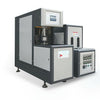
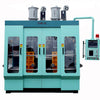
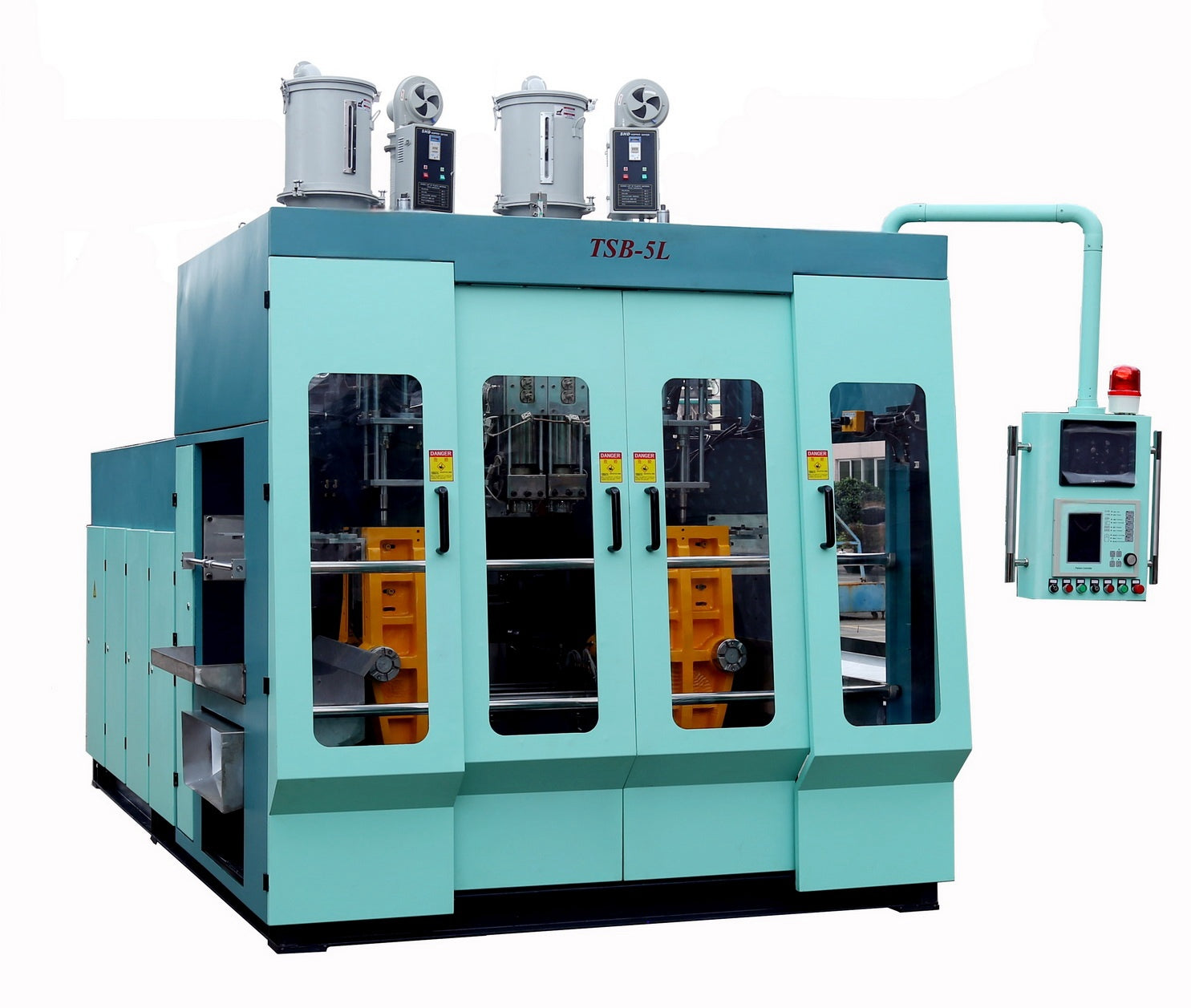
A representative 5L extrusion blow molding machine (based on the SCJ-85 series) includes the following specifications [4][9]:
| Component | Specification |
|---|---|
| Main Screw Diameter | 85 mm |
| L/D Ratio | 24:1 |
| Extruder Motor Power | 37 kW |
| Plasticizing Capacity | 130 kg/h (HDPE) |
| Die Head Type | Continuous central-feed |
| Die Head Heating Zones | 5 |
| Clamping Force | 196 kN |
| Mold Opening Stroke | Up to 750 mm |
| Template Size | 600 × 500 mm |
| Blow Pressure | 0.6–0.8 MPa |
| Cooling Water Flow | ~0.5 m³/min |
| Cycle Time | ≤28 s |
| Output (Dual-Station) | Up to 1,100–1,200 pcs/h |
The dual-station linear guide rail system ensures smooth mold carriage movement, reduces vibration, and enhances positioning repeatability—critical for consistent 5L bottle quality over long production runs [4][9].
3. Wall Thickness Control and Product Quality
Uniform wall distribution is essential for 5L containers to pass drop tests (e.g., ASTM D2911) and resist internal pressure from viscous or volatile contents. Modern 5L machines implement:
- Multi-point parison control: Up to 32 programmable zones adjust die gap during extrusion, compensating for sag and ensuring optimal material distribution [1].
- Infrared parison positioning: Aligns the hot parison with the mold cavity within ±0.5 mm, minimizing flash and reducing scrap rates to <0.5% [11].
- Pre-blow and sequential blowing: Prevents parison adhesion and ensures even expansion, especially in deep-draw geometries like narrow-neck chemical drums [1].
These technologies enable wall thickness variation of <±0.15 mm, allowing 8–12% material savings without compromising burst strength (>0.3 MPa)—a key requirement for industrial and automotive packaging [4][7].
4. Energy Efficiency and Sustainability
Energy consumption is a major operational cost in plastic processing. Two key innovations now standard in 5L EBM machines are:
4.1 Variable Frequency Drives (VFDs)
Traditional hydraulic systems run oil pumps at fixed speed (50 Hz), wasting energy via overflow valves. VFDs modulate motor speed based on real-time demand. According to pump affinity laws:
Reducing motor frequency from 50 Hz to 35 Hz cuts power consumption by ~65%. Field data show 25–65% energy savings after VFD integration [1][2].
4.2 Electromagnetic Heating
Replacing resistive heaters with induction coils offers:
- 30–70% higher thermal efficiency,
- 25% faster warm-up,
- Reduced ambient heat loss due to integrated insulation [1].
For a 5L machine operating 20 hours/day, annual energy savings reach 10,000–15,000 kWh, aligning with China’s “Dual Carbon” policy and ISO 50001 energy management standards [2][5].
5. Material Flexibility and Circular Economy Integration
Modern 5L EBM machines support a wide range of thermoplastics:
- HDPE (most common for chemical resistance),
- PP (for high-temperature applications),
- Recycled HDPE (rHDPE)—up to 100% in non-food applications [11].
Advanced co-extrusion systems (e.g., 4-layer: virgin/rHDPE/opaque/pigmented) allow manufacturers to use dark recycled cores while maintaining bright, clean exteriors—enabling circular economy compliance without sacrificing aesthetics [11].
6. Industrial Applications
The 5L format is ideal for:
- Automotive: Transmission fluid, coolant, and brake fluid reservoirs,
- Agriculture: Herbicide and pesticide containers,
- Household: Bulk laundry detergent and floor cleaner bottles,
- Industrial: Solvent drums, lubricant carriers, and reagent vessels.
Its balance of capacity, stackability, and drop resistance makes it a logistics favorite across global supply chains [7].
7. Future Trends
The next generation of 5L EBM machines will likely feature:
- Full-electric servo clamping (eliminating hydraulic oil and noise),
- IoT-enabled remote monitoring with predictive maintenance,
- AI-driven process optimization using digital twins,
- Integration with robotic palletizing for lights-out manufacturing [5][10].
Moreover, modular design and quick-change tooling will shorten setup times—critical for FMCG brands managing hundreds of SKUs.
8. Conclusion
The 5-liter extrusion blow molding machine stands at the intersection of industrial robustness and high-efficiency automation. Through dual-station architecture, intelligent parison control, and advanced energy-saving systems, it delivers reliable, low-waste production of essential containers across automotive, chemical, and consumer sectors. As global regulations tighten on plastic waste and carbon emissions, the 5L EBM machine—especially when paired with recycled feedstock and smart controls—will remain a cornerstone of sustainable, scalable packaging manufacturing. In China and beyond, its evolution reflects the broader shift toward green, intelligent, and human-centered industrial machinery.
-
Đăng trong
extrusion blow molding machine