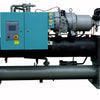
Water-cooled chiller
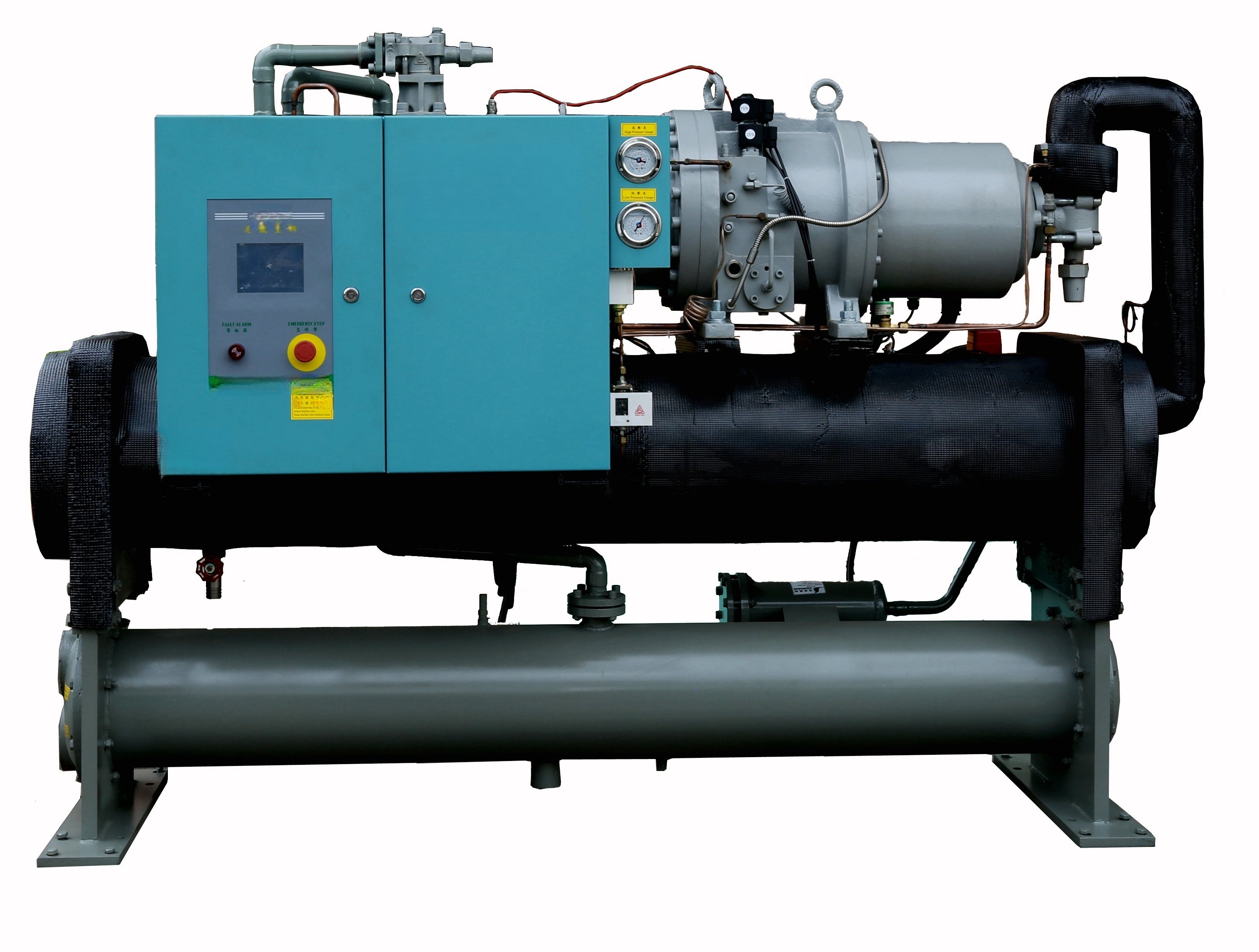
A Comprehensive Review of Water-Cooled Screw Chillers: Principles, Performance, and Advancements
Abstract
Water-cooled screw chillers are widely employed in commercial and industrial air-conditioning and refrigeration systems, offering reliable cooling capacity across a broad range of applications. This paper provides a comprehensive review of water-cooled screw chillers, covering their fundamental working principles, system components, performance characteristics, and recent technological advancements. The vapor-compression refrigeration cycle—comprising compression, condensation, throttling, and evaporation—is examined in detail. Key components including the twin-screw compressor, shell-and-tube condenser, evaporator, expansion valve, and oil management system are discussed. Performance optimization strategies, including second-law thermodynamic analysis, two-stage compression technology, variable-frequency drive, and parallel throttling mechanisms, are reviewed. Recent developments have demonstrated that advanced water-cooled screw chillers can achieve coefficients of performance (COP) exceeding 7.0 under nominal operating conditions, representing significant improvements over conventional designs. The paper also addresses applications across HVAC systems, industrial processing, and emerging trends in energy efficiency and sustainability.
Keywords: water-cooled screw chiller; screw compressor; vapor-compression refrigeration; coefficient of performance (COP); energy efficiency; two-stage compression
1. Introduction
Vapor-compression liquid chillers have been commonly used to cool water, brine, and other secondary coolants in commercial and industrial air-conditioning or refrigeration systems-8. Among the various chiller types available, water-cooled screw chillers have gained widespread acceptance due to their high cooling capacities, energy efficiency, and operational reliability, distinguishing them from other refrigeration technologies-.
A screw chiller is an industrial chiller that utilizes a semi-hermetic screw-type compressor-. Water-cooled screw chillers use water as the cooling medium for heat rejection, typically in conjunction with cooling towers-. This water-cooled approach offers superior thermal exchange efficiency compared to air-cooled counterparts, especially in environments where ambient air temperatures are high or space for heat rejection is limited-.
The energy consumption of water chillers can account for up to 70% of air-conditioning energy consumption under the most adverse operating conditions-56. Consequently, improving the energy efficiency of these systems has become a critical priority for both economic and environmental reasons. Recent research has focused on enhancing the coefficient of performance (COP) through advanced compressor technologies, optimized heat exchanger designs, and sophisticated control strategies.
This paper aims to provide a systematic review of water-cooled screw chillers, covering their working principles, key components, performance characteristics, and recent technological innovations. The structure of this paper is as follows: Section 2 presents the fundamental working principles based on the vapor-compression refrigeration cycle; Section 3 examines the major system components; Section 4 discusses performance evaluation and optimization strategies; Section 5 reviews recent technological advancements; Section 6 covers applications; and Section 7 provides concluding remarks.
2. Working Principles
2.1 The Vapor-Compression Refrigeration Cycle
Water-cooled screw chillers operate on the fundamental principles of the vapor-compression refrigeration cycle-. The cycle consists of four key processes: compression, condensation, throttling (expansion), and evaporation-44.
Compression Process: The compressor draws low-temperature, low-pressure refrigerant vapor from the evaporator-42. Through the rotational motion of the screw rotors, the refrigerant vapor is compressed to a high-temperature, high-pressure state and discharged into the condenser-44.
Condensation Process: The high-pressure, high-temperature refrigerant vapor enters the condenser, where it releases heat to the circulating cooling water-44. As heat is removed, the refrigerant condenses into a high-pressure liquid. The cooling water temperature rises as it absorbs heat from the refrigerant-44.
Throttling (Expansion) Process: The high-temperature, high-pressure liquid refrigerant from the condenser passes through the expansion device-44. Upon passing through the throttling device, the refrigerant undergoes pressure reduction and expansion, becoming a low-temperature, low-pressure liquid that enters the evaporator-44.
Evaporation Process: The low-pressure, low-temperature liquid refrigerant absorbs heat from the chilled water within the evaporator, evaporating into a vapor-44. This heat absorption causes the chilled water temperature to decrease, producing the desired cooling effect-42. The refrigerant vapor is then drawn back into the compressor, repeating the cycle continuously-44.
2.2 The Role of Water as a Cooling Medium
In water-cooled screw chillers, water serves dual purposes: as the cooling medium in the condenser and as the chilled medium in the evaporator. In the condenser, cooling water (typically from a cooling tower) removes heat from the refrigerant, enabling condensation-. In the evaporator, chilled water transfers heat to the refrigerant, resulting in temperature reduction for air-conditioning or process cooling applications-44.
The water-cooled approach provides several advantages over air-cooled systems. Water has higher thermal conductivity and specific heat capacity than air, enabling more efficient heat transfer. Additionally, water-cooled chillers are not dependent on ambient air temperature for heat rejection, allowing for stable performance even in high-temperature environments-.
3. System Components
3.1 Screw Compressor
The screw compressor is the heart of the water-cooled screw chiller-44. It is responsible for compressing the refrigerant vapor and driving the entire refrigeration cycle-. The compressor typically employs a twin-screw (or dual-screw) configuration featuring a pair of intermeshing male and female rotors-46. As the rotors rotate, the refrigerant gas is trapped in the grooves between the rotors and the compressor casing, progressively compressed, and discharged at the outlet-.
Screw compressors offer several advantages over other compressor types. They have relatively few moving parts, resulting in high reliability and low maintenance requirements-42. They are tolerant of liquid carryover (wet compression) without risk of damage from liquid slugging-42. Furthermore, screw compressors can operate efficiently across a wide range of capacities through capacity control mechanisms such as slide valves-46.
Modern screw compressors often incorporate variable-frequency drives (inverters) that enable continuous capacity modulation-. This allows the compressor to match the cooling load precisely, significantly improving part-load efficiency-.
3.2 Condenser
The condenser is a heat exchanger that removes heat from the compressed refrigerant vapor, causing it to condense into a liquid-44. Water-cooled screw chillers typically employ shell-and-tube condensers, in which the refrigerant flows through the shell side while cooling water circulates through the tubes-.
The heat transfer efficiency of the condenser is critical to overall chiller performance. Advanced condenser designs incorporate features such as enhanced tube surfaces and optimized tube arrangements to maximize heat transfer-. When the copper tubes are immersed in the refrigerant, strong nucleate boiling forms on the tube surface, yielding high heat transfer efficiency-.
3.3 Evaporator
The evaporator is where the actual cooling effect is produced. Liquid refrigerant absorbs heat from the chilled water and evaporates-44. Like the condenser, the evaporator in water-cooled screw chillers is typically of the shell-and-tube type-.
Two common evaporator designs are used in screw chillers: flooded evaporators and falling-film evaporators. In flooded evaporators, the refrigerant pool covers the heat transfer tubes, providing excellent heat transfer but requiring a larger refrigerant charge. Falling-film evaporators distribute refrigerant as a thin film over the tube surfaces, offering high heat exchange efficiency with reduced refrigerant charge-.
3.4 Expansion Device
The expansion device (throttling valve) controls the flow of refrigerant from the condenser to the evaporator and reduces the refrigerant pressure-44. Common types include thermal expansion valves (TXVs) and electronic expansion valves (EEVs).
Recent research has explored the use of parallel throttling mechanisms to improve part-load performance. Experimental studies have shown that under part-load conditions, parallel throttling can reduce the exergetic loss of the evaporator by 3.4% to 15.5% and enhance the COP by 0.2% to 1.6%-56.
3.5 Oil Management System
Proper oil management is essential for reliable screw compressor operation. The oil serves to lubricate the bearings and rotors and to seal the clearances between the rotors-44. However, oil inevitably mixes with the refrigerant and circulates through the system.
The oil management system includes an oil separator located between the compressor discharge and the condenser-44. The oil separator removes the majority of the oil from the discharged refrigerant gas and returns it to the compressor suction-44. A secondary oil return system handles any oil that escapes the primary separator and accumulates in the evaporator-44.
3.6 Control System
The control system manages the operation of the chiller, ensuring safe and efficient performance. Modern water-cooled screw chillers employ microprocessor-based controllers or programmable logic controllers (PLCs)-46. These controllers monitor various parameters including temperatures, pressures, flow rates, and electrical currents-.
The control system provides multiple protection functions, including high-pressure protection, low-pressure protection, water cutoff protection, over-current protection, voltage protection, discharge temperature protection, and sensor fault detection-. Capacity control is typically achieved through slide valve positioning, enabling stepless capacity modulation from 10% to 100% of full load-46.
4. Performance Evaluation and Optimization
4.1 Performance Metrics
The energy efficiency of liquid chillers is typically evaluated using several metrics, including the coefficient of performance (COP), the energy efficiency ratio (EER), and the input energy ratio (kW/RT)-8. The COP is defined as the ratio of cooling capacity to power input:
COP=WinputQcooling
Conventional performance evaluations are based on the first law of thermodynamics, which considers only the quantity of energy-8. However, the first law does not account for the quality of energy or the irreversibilities within the system-8.
4.2 Second-Law (Exergy) Analysis
Second-law (exergy) analysis provides a more comprehensive approach to evaluating chiller performance by considering both the quantity and quality of energy-8. Exergy analysis quantifies the destruction of available energy (exergy destruction) in each system component, identifying the sources of irreversibility and the potential for improvement-.
Studies applying second-law analysis to screw liquid chillers have found that the compressor has the largest potential for improving energy efficiency, followed by the condenser and then the evaporator-7-8. This analysis helps engineers focus on components with higher exergy destruction and quantify the effects of modifications-7.
4.3 Part-Load Performance
Chillers rarely operate at full load for extended periods. A significant portion of operating time is spent under part-load conditions, making part-load efficiency a critical consideration-56. The Integrated Part-Load Value (IPLV) is a metric that accounts for chiller performance across various load conditions.
Recent research has explored various strategies to improve part-load performance. The parallel throttling mechanism has been shown to enhance COP by 0.2% to 1.6% under part-load conditions while reducing discharge temperature-56. Variable-speed drives enable the compressor to operate at speeds that precisely match the cooling demand, significantly improving part-load efficiency-.
5. Recent Technological Advancements
5.1 Two-Stage Compression Technology
Two-stage compression technology, traditionally used in large-capacity chillers, has recently been applied to medium-capacity water-cooled screw chillers with remarkable results-. A two-stage compression water-cooled screw chiller with a nominal cooling capacity of 615.48 kW was developed employing a novel rotor profile and structural design-9.
The experimental results demonstrated that the volumetric efficiency of the two-stage variable-frequency twin-screw compressor exceeded 96%, with a maximum isentropic efficiency of 84.4%-9. The chiller achieved a COP of 7.01 under nominal operating conditions (chilled water outlet temperature of 7°C), which is 16.83% higher than the first-degree energy efficiency requirement specified in GB 19577—2015-9. The IPLV reached 10.45, exceeding the standard by 39.33%-9. Compared to designs without intermediate cooling, the cooling capacity and COP increased by more than 11% and 8%, respectively-9.
5.2 Ultra-Efficient Dual Screw Chillers
Serial water loops in multiple screw chillers have been identified as having the potential to improve COP above 7.0-13. Energy and exergy analyses have shown that water-cooled multiple screw chillers with serial water loops have the maximum potential to increase COP by 26.02% and exergy efficiency by approximately 22% relative to single screw chillers under normal operating conditions-13.
Based on these analyses, ultra-efficient dual screw chillers have been developed and tested, achieving a COP of 7.22 and an IPLV of 9.50—values that exceed the minimum allowable first-order energy efficiency for water chillers by 20.3% and 26.67%, respectively-13.
5.3 Variable-Frequency and Inverter Technology
Variable-frequency drives (VFDs) have become increasingly common in water-cooled screw chillers. Inverter-driven screw compressors allow for continuous capacity modulation, enabling precise matching of cooling output to load requirements-.
Advanced control strategies such as VI (volume index) optimization automatically adjust the compressor's internal volume ratio to match the operating conditions, avoiding under-compression or over-compression losses-. This optimization reduces power consumption and improves part-load efficiency-. Field studies have shown that variable-speed screw chillers can achieve energy savings of 30% or more compared to the chillers they replace-.
5.4 Advanced Heat Exchanger Designs
Innovations in heat exchanger design have contributed significantly to efficiency improvements. Enhanced tube surfaces promote nucleate boiling in evaporators, increasing heat transfer coefficients-. Falling-film evaporators offer high heat exchange efficiency with reduced refrigerant charge-. Optimized tube arrangements and liquid distribution systems ensure uniform refrigerant distribution and sufficient heat exchange-.
6. Applications
6.1 Commercial HVAC Applications
Water-cooled screw chillers are extensively used in commercial buildings for space air-conditioning-. They are ideal for hotels, shopping malls, hospitals, office buildings, and other large commercial complexes that require centralized air conditioning--46.
The ability to provide consistent chilled water output with minimal maintenance makes them particularly suitable for applications where reliability is paramount-. The compact design of modern screw chillers facilitates installation in mechanical rooms with space constraints-.
6.2 Industrial Applications
Beyond commercial HVAC, water-cooled screw chillers find extensive use in industrial process cooling-. Applications include the plastic and rubber industry for mold temperature control-, electroplating, food processing, and chemical processing-. They are also employed in data centers, pharmaceutical manufacturing, and beverage production-.
A notable example is the installation of a 100-ton water-cooled screw chiller at a Pepsi Cola manufacturing facility, where it maintains precise low temperatures (1°C to 4°C) for CO₂ solubility and beverage stability-. In the automotive industry, screw chillers have been integral to energy award-winning systems that reduced annual energy costs by 70%-.
6.3 Large-Scale Systems
The cooling capacity of water-cooled screw chillers ranges broadly, from approximately 124.9 kW to over 3,200 kW-46. Major manufacturers offer units with nominal cooling capacities spanning 273 kW to 1,756 kW-. This wide capacity range makes screw chillers suitable for both medium-scale and large-scale applications-13.
7. Market Trends and Future Outlook
The global screw chillers market has been experiencing steady growth, driven by increasing demand for energy-efficient cooling solutions across various industries-. The market size for screw chillers was estimated at US$2.6 billion in 2025 and is projected to reach US$3.4 billion by 2031, growing at a CAGR of 6.4%-. The water-cooled screw chiller segment alone is expected to grow from US$6.7 billion in 2025 to US$9.2 billion in 2031 at a CAGR of 5.5%-.
China, as the world's second-largest economy, is forecast to reach a projected market size of US$740.3 million for screw chillers by 2032-. The Chinese market for variable-frequency water-cooled screw chillers reached RMB 9.116 billion in 2025 and is expected to reach RMB 13.12 billion by 2032-.
Future trends in the water-cooled screw chiller industry are likely to focus on further efficiency improvements, the adoption of low-global-warming-potential refrigerants, enhanced controllability through digitalization and IoT integration, and the development of heat pump applications for simultaneous cooling and heating.
8. Conclusion
Water-cooled screw chillers represent a mature yet continuously evolving technology that plays a vital role in commercial and industrial cooling applications. Their operation is based on the vapor-compression refrigeration cycle, with the twin-screw compressor serving as the core component. Key system components include the condenser, evaporator, expansion device, oil management system, and advanced control systems.
Performance optimization has been advanced through second-law exergy analysis, which identifies compressors as having the greatest potential for efficiency improvement, followed by condensers and evaporators. Recent technological breakthroughs—including two-stage compression, variable-frequency drives, parallel throttling mechanisms, and advanced heat exchanger designs—have pushed COP values beyond 7.0, representing substantial improvements over conventional designs.
As global energy demand continues to rise and environmental concerns intensify, water-cooled screw chillers will remain essential for achieving efficient, reliable, and sustainable cooling solutions. Ongoing research and development efforts are expected to yield further efficiency gains, expanded application ranges, and enhanced operational flexibility, ensuring the continued relevance of this technology in the years to come.
-
Posted in
Industrial chiller