Plastic Granulators: Technological Evolution, Market Dynamics, and the Role in Advancing Circular Economy Abstract
1. Introduction
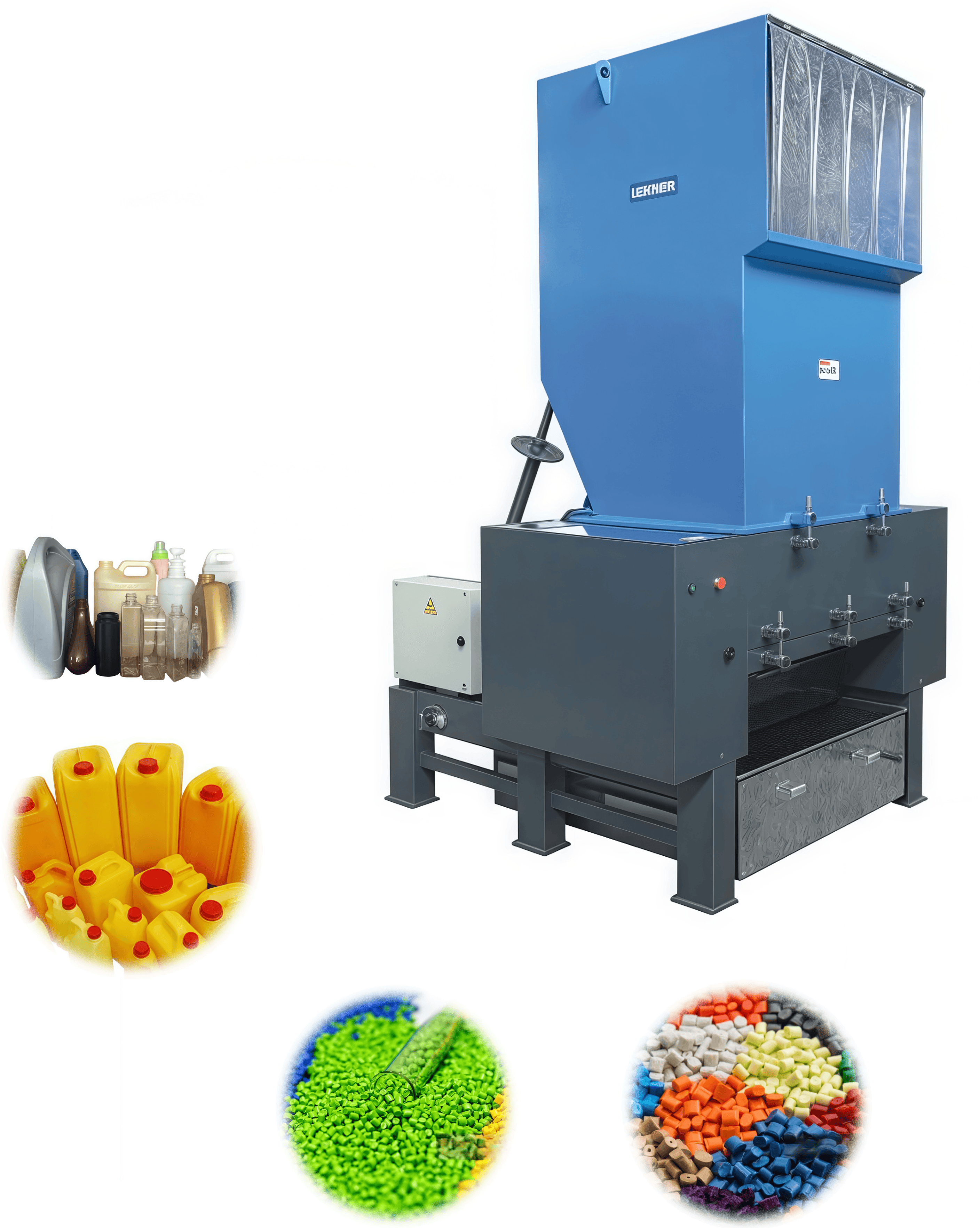
Global plastic waste generation exceeded 400 million tons in 2024, with only 9% effectively recycled worldwide [5]. In China, 19.5 million tons of plastic were recovered—a 2.6% increase from 2023—but over 75% of this volume requires mechanical size reduction before regeneration [1][5]. At the heart of this preprocessing stage lies the plastic granulator, a machine designed to convert bulky, irregular plastic scrap into consistent granules (typically 3–12 mm) for downstream recycling.
Despite its critical role, the granulator is often misunderstood—as either too simple or too specialized. This paper clarifies its technical sophistication, economic significance, and environmental impact in the context of rising regulatory pressure and circular economy mandates.
2. Classification and Working Principle
Plastic granulators are broadly categorized into three functional types [5][11]:
- Hard-Plastic Granulators: Optimized for rigid sheets and plates (e.g., ABS, PP boards). Feature rectangular feed hoppers and claw-type knives.
- Heavy-Duty (Powerful) Granulators: General-purpose units for mixed streams—bottles, containers, packaging, e-waste housings. Use flat or hybrid blades and robust frames.
- Pipe-Specific Granulators: Equipped with cylindrical inlets for long tubes (PVC, PE pipes), preventing jamming during feeding.
The core mechanism relies on shear-based comminution: a high-torque motor drives a rotor fitted with rotating knives that pass closely by stationary knives mounted on the chamber wall. The resulting scissor-like action fractures the plastic through brittle fracture under high strain rates [11]. Granule size is controlled by interchangeable screen meshes, while airflow or conveyors remove fines.
Key components include:
- Sealed bearings to prevent powder ingress,
- Alloy steel knives (e.g., SKD11, DC53) with heat-treated edges,
- Modular housing for easy maintenance [11].
3. Technological Innovations (2020–2026)
3.1 Intelligent Control Systems
Modern granulators increasingly integrate PLC + HMI interfaces and IoT-enabled remote monitoring. For example, Henan Boson Industrial’s smart granulator features:
- Real-time load sensing,
- Automatic jam reversal via hydraulic actuation,
- Predictive maintenance alerts,
- Remote parameter adjustment via mobile app [8].
These systems reduce downtime by up to 30% and lower labor dependency—critical for small-to-medium recyclers.
3.2 Material and Structural Upgrades
- Knife longevity: Advanced coatings and nano-composite alloys extend service life by 2× compared to standard tool steel [1][9].
- Noise suppression: Dual-wall chambers with acoustic insulation achieve <65 dB, meeting urban industrial noise limits [8].
- Dust control: Negative-pressure dust extraction and sealed operation ensure compliance with occupational health standards [8].
3.3 Energy Efficiency
Motors constitute >20% of total material cost [1][9], prompting adoption of:
- Variable-frequency drives (VFDs) that match power to load,
- High-efficiency IE3/IE4 motors aligned with China’s GB 38507-2024 energy standard,
- Optimized gear ratios to minimize idle loss [1].
4. Cost Structure and Economic Considerations
A typical mid-range granulator’s cost breakdown reveals strategic shifts toward value-added features [1][9]:
| Cost Category | Share | Notes |
|---|---|---|
| Raw Materials | ~50% | Motor alone >20%; alloy knives ~10% |
| Production | ~20% | Equipment depreciation >30% of this segment |
| Marketing | ~15% | Advertising >50% of marketing spend |
| Management | ~10% | Salaries >60% of admin costs |
| Intelligence Premium | +20% | Smart models cost 20% more than basic units |
Despite higher upfront investment, intelligent granulators deliver ROI within 12–18 months through reduced labor, energy savings, and extended component life [8].
5. Applications Across Industries
| Sector | Feedstock | Granulator Type | Output Requirement |
|---|---|---|---|
| Beverage Recycling | PET bottles, caps | Heavy-duty | High throughput (>1 t/h), low contamination |
| Construction | PVC/PE pipes, profiles | Pipe-specific | Long-feed capability, coarse granules |
| Automotive | Bumpers, dashboards (PP/ABS) | Hard-plastic | Fine, uniform particles for re-injection |
| E-Waste | Computer housings | Heavy-duty + magnetic separator | Mixed-material tolerance |
| Injection Molding | Sprues, runners | On-site granulator | Clean, dry granules for immediate reuse [5][11] |
Crucially, granulation is only the first step: output must undergo washing, drying, and extrusion to become usable rPET or rPP [4].
6. Policy and Market Drivers
6.1 Regulatory Push
- China: “Circular Economy Promotion Law” and “Zero-Waste Cities” pilot programs mandate 30% packaging recyclability by 2025 [1][5].
- EU: Extended Producer Responsibility (EPR) schemes require brands to fund collection and processing infrastructure.
- Local Emissions Standards: Dust and noise limits force upgrades to enclosed, filtered systems [8].
6.2 Market Growth
- China’s plastic granulator market: ¥4.5 billion in 2024 (+18.4% YoY) [1][5][9].
- Global small granulator market: projected to reach hundreds of billions USD by 2025 [1].
- Export surge: Chinese OEMs now supply Southeast Asia, Africa, and Latin America, leveraging 30–40% cost advantage over European brands [5].
Leading domestic players include:
- Zhejiang Fengli: Known for high-capacity industrial lines,
- Shanghai Huasan: Specializes in fine-powder applications,
- Henan Boson: Pioneer in smart, eco-friendly mid-tier models [5][8].
7. Challenges and Future Outlook
Despite progress, key challenges remain:
- Fragmented competition: Top 10 firms hold only ~60% market share, limiting R&D scale [8].
- rPET compatibility: Recycled content introduces thermal instability, demanding adaptive granulation.
- Overcapacity in low-end segment: Price wars erode quality and innovation incentives [5].
Future directions include:
- AI-driven adaptive control based on real-time material analysis,
- Modular “plug-and-play” systems for SMEs,
- Integration with washing and pelletizing lines for turnkey recycling plants,
- Use of bio-based or self-lubricating composites in non-critical components [1][9].
8. Conclusion
Plastic granulators have evolved from basic cutting machines into intelligent, environmentally compliant, and economically strategic assets in the circular plastics value chain. As global waste volumes rise and regulations tighten, their role will only grow more central—not just in breaking down plastic, but in rebuilding a resource-efficient future. The next decade will belong to manufacturers who combine robust engineering, digital intelligence, and deep sustainability commitment.
-
Posted in
Plastic crusher