Extrusion Blow Molding Machines: Principles, Technologies, and Industrial Applications Abstract
1. Introduction
Extrusion blow molding (EBM) emerged during World War II for producing low-density polyethylene (LDPE) bottles and rapidly evolved with the advent of high-density polyethylene (HDPE) in the 1950s [1][3]. Today, it remains the dominant process for fabricating hollow plastic parts due to its simplicity, cost-effectiveness, and adaptability across industries—from daily chemical packaging to automotive fuel tanks and industrial IBC totes [1][2].
The fundamental principle involves extruding a molten tubular parison, capturing it in a cooled mold cavity, inflating it with compressed air, and solidifying it into the final shape [3][5]. Despite its apparent simplicity, achieving consistent wall thickness, minimizing sag, and ensuring rapid cycle times demand sophisticated machine design and precise process control.
This paper synthesizes current knowledge on EBM machine architecture, technological innovations, material systems, and sustainability performance, drawing on authoritative sources including Baidu Baike’s 2025 technical summaries and recent patents [1][3][4].
2. Working Principle and Process Steps
The EBM process consists of five sequential stages [1][5]:
- Parison Extrusion: Molten polymer is forced through an annular die to form a seamless tube (parison).
- Mold Closure: The parison is pinched between two mold halves; excess material at the top and bottom is trimmed.
- Blow Inflation: Compressed air (typically 0.3–0.7 MPa) is injected through a needle or mandrel, expanding the parison against the mold walls.
- Cooling and Solidification: Internal air pressure is maintained while cooling channels extract heat, solidifying the part.
- Ejection and Trimming: The mold opens, the part is removed, and flash (excess material) is trimmed off.
This cyclic process enables continuous or semi-continuous production, with cycle times ranging from 6 seconds (for 500 mL bottles) to several minutes (for large industrial drums) [3][5].
3. Machine Classification and Core Components
3.1 Types of EBM Machines
EBM machines are broadly categorized as:
- Continuous Extrusion Blow Molding: Suitable for high-volume, small-to-medium containers (e.g., milk jugs). Subtypes include shuttle, rotary, and reciprocating designs [3].
- Accumulator-Head (Storage-Type) Blow Molding: Used for large or thick-walled parts where parison sag must be minimized. Molten polymer is stored in a cylinder and ejected rapidly (<1 s), enabling precise volume control [3][5].
Accumulator systems support shot sizes from 1 kg to 240 kg and feature up to 128-point axial thickness control, critical for fuel tanks and chemical drums [3].
3.2 Key Subsystems
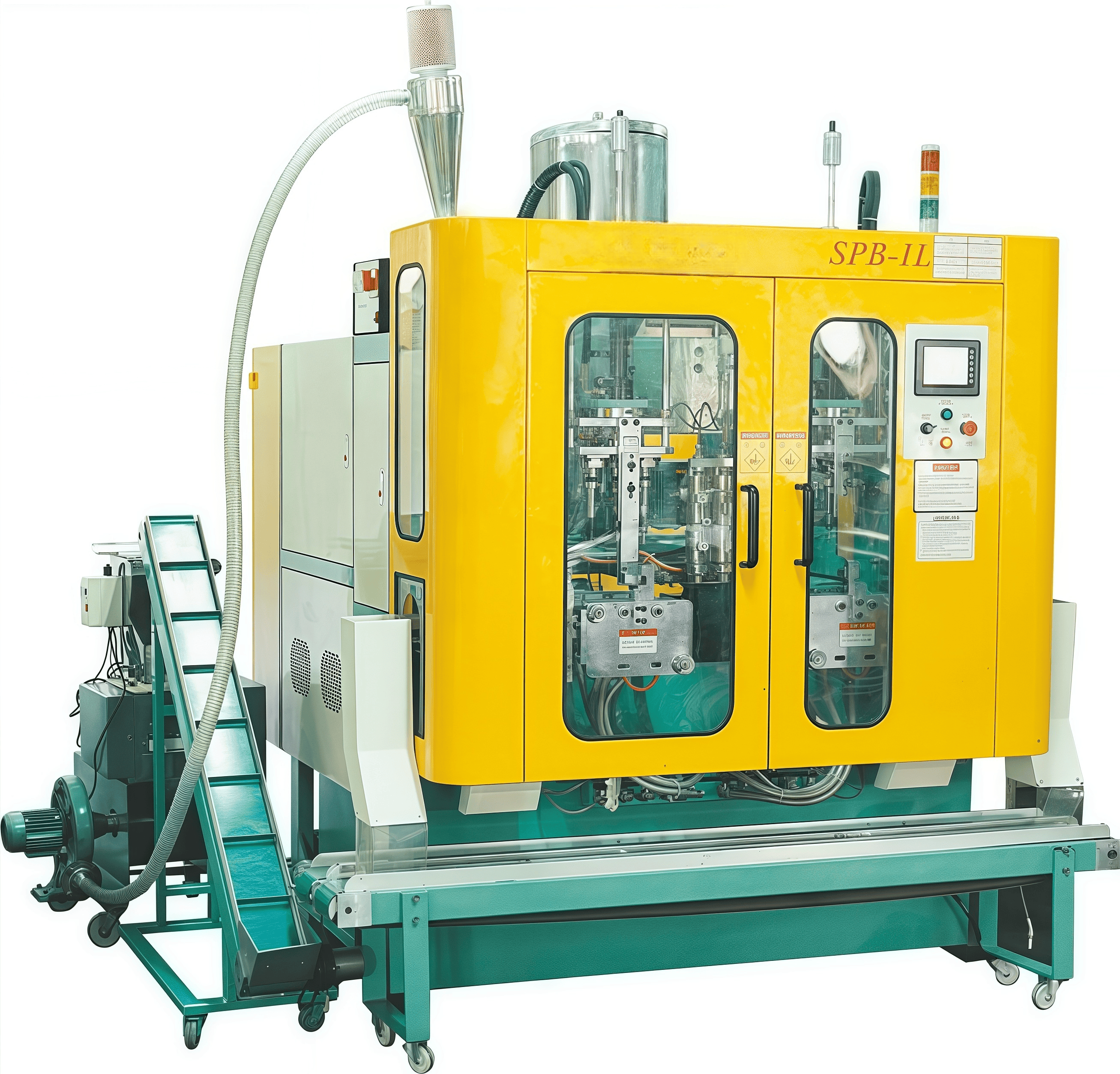
- Extruder: A single-screw unit (L/D = 25:1–32:1) melts resin (e.g., HDPE, PP, PVC) at 180–230°C. Screw barrels are often made of nitrided alloy steel for wear resistance [3][9].
- Die Head: Central or side-fed annular dies with streamlined flow paths prevent melt stagnation. Multi-layer versions enable 2–7 layer co-extrusion for barrier functionality [5].
- Mold System: Hydraulic or servo-electric clamping provides precise alignment and sealing force. Linear guide rails ensure smooth movement [4].
- Parison Thickness Control: Modern systems use asynchronous motors or servo actuators to adjust mandrel position in real time, achieving wall tolerances within ±0.1 mm [4][5].
4. Material Compatibility
EBM accommodates a wide range of thermoplastics [1][2]:
| Material | Key Properties | Common Applications |
|---|---|---|
| HDPE | Chemical resistance, toughness | Milk bottles, detergent containers, fuel tanks |
| PP | High melting point, fatigue resistance | Automotive ducts, medical vials |
| PVC | Clarity, rigidity | Cosmetic bottles, medical tubing |
| PET | Barrier properties, transparency | Beverage bottles (via stretch-blow variants) |
| PC | Impact strength, optical clarity | Water cooler bottles, solar tanks |
Recycled content (PCR-PE/PP) is increasingly used—especially in Europe and China—driven by circular economy mandates requiring ≥30% post-consumer material in packaging [2][8].
5. Energy Efficiency and Smart Technologies
Recent EBM machines prioritize sustainability through:
- Electromagnetic Heating: Replaces resistive heaters, reducing energy loss by 30–70% via direct barrel induction and improved insulation [3].
- Variable Frequency Drives (VFDs): Match motor output to actual load, cutting idle power consumption by 20–30% [3].
- Servo-Electric Actuation: Eliminates hydraulic oil, lowers noise (<75 dB), and improves positioning accuracy [4].
- PLC + HMI Control: Enables recipe storage, real-time monitoring, multilingual interfaces, and remote diagnostics [3][4].
According to industry data, smart EBM machines now account for over 32% of global sales (up from 18% in 2020), with projections exceeding 40% by 2025 [2].
6. Applications Across Industries
- Packaging: 1L shampoo bottles, 20L chemical drums, food-grade containers.
- Automotive: Fuel tanks (HDPE/EVOH/HDPE), seat backrests, air ducts [1].
- Consumer Goods: Toys, sports equipment, furniture shells [1].
- Industrial: IBC totes, lubricant barrels, marine buoys.
Notably, EBM is the only viable method for producing large, seamless, impact-resistant containers that cannot be injection-molded due to undercuts or size constraints [3].
7. Challenges and Future Outlook
Despite its strengths, EBM faces limitations:
- Difficulty achieving radial wall uniformity without complex die designs.
- Limited suitability for ultra-thin or highly intricate geometries.
- Higher initial cost for accumulator-head systems.
Future R&D focuses on:
- AI-driven digital twins for predictive parison control,
- All-electric accumulator systems,
- In-line spectroscopy for melt quality assurance,
- Integration with automated trimming and leak-testing for end-to-end smart factories.
China’s “dual carbon” policy and global ESG pressures will further accelerate adoption of green, intelligent EBM solutions [2][8].
8. Conclusion
The extrusion blow molding machine exemplifies the synergy between mechanical engineering, polymer science, and sustainable manufacturing. Through continuous innovation in parison control, energy efficiency, and automation, modern EBM systems deliver high-quality, cost-effective, and eco-conscious solutions for a vast array of hollow plastic products. As industries worldwide embrace circularity and digital transformation, EBM technology will remain indispensable in the future of plastic processing.
-
Posted in
extrusion blow molding machine